Ubuntu 26.10: New Features
Canonical has released Ubuntu 26.10, codenamed “Stonking Stingray,” which adds Myna, an opt-in speech-to-text agent that runs on local models. The release also completes the move to Rust-based coreutils, adds post-quantum package signing, and strengthens Microsoft Entra ID sign-in. Canonical describes it as an interim release that builds on established ground while looking toward the future.
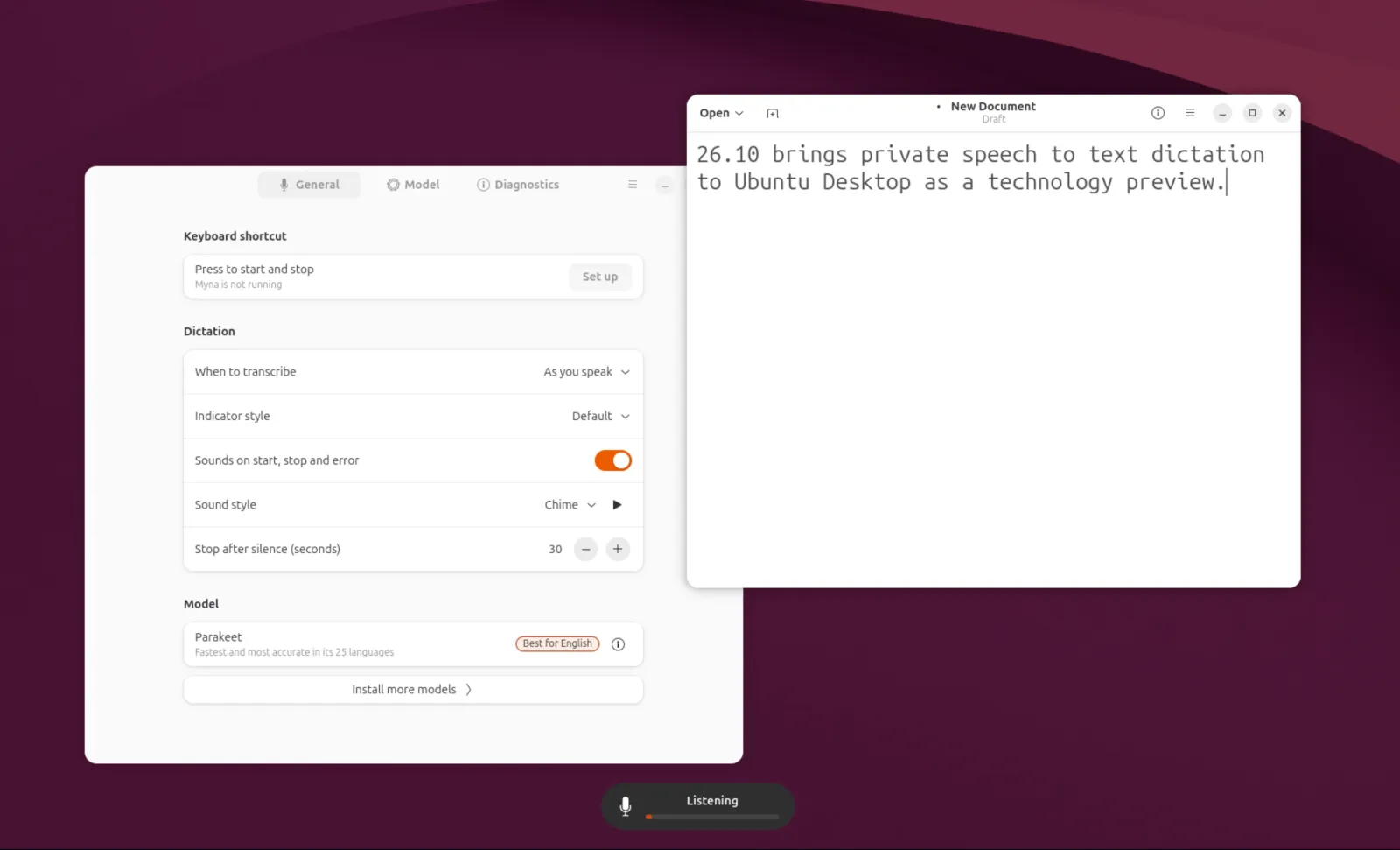
Myna is the first milestone of the AI roadmap Canonical set out earlier this year. Named after the Myna bird, known for its ability to mimic human speech, it provides speech recognition with clear visual feedback while you speak. Because it is based on local models, it offers speech-to-text without sacrificing privacy. Canonical says Myna will keep evolving and will be included by default with Ubuntu as Ubuntu 28.04 LTS approaches.
Canonical frames Myna as the start of a more natural, intent-driven desktop, where users express what they want to achieve rather than navigating applications and settings manually. As an example, a developer could say, “Help me investigate why my tests are failing,” and Ubuntu could analyze test results, locate relevant code, and prepare a workspace with the tools needed to troubleshoot the issue. Canonical also says this is Ubuntu's first AI integration with accessibility.
Ubuntu 26.10 ships with GNOME 51, which brings a smoother, more responsive desktop, better display handling, improved accessibility, and refinements across core applications. The Ubuntu App Center now offers a more consistent experience for managing snaps and debs. Assistive technologies such as Orca (screen reader) can better parse and understand content in Flutter applications. The release also adopts dbus-broker as the default D-Bus implementation, replacing legacy message queuing between apps with strict per-app message accounting, so a single app cannot stall the desktop. Desktop OOM (out-of-memory protection) scoring has also been adjusted to better manage memory pressure in userspace.
Ubuntu Desktop integrates more closely with Microsoft identity services, including password plus Multi-Factor Authentication (MFA) and passwordless sign-in. Canonical says this lets devices authenticate securely by default, under the same security umbrella as Windows devices in the same organization.
TPM-backed full-disk encryption, rolled out in Ubuntu 26.04 LTS, now extends to hardware models that lack a Hardware Root of Trust, and users can require a PIN or passphrase.
The release also completes the migration to Rust-based coreutils, the uutils coreutils rewrite. For package signing, Ubuntu 26.10 replaces GnuPG with Sequoia PGP to verify APT repository signatures. Canonical says Sequoia brings Rust's memory-safe practices to package signing and acts as a barrier against quantum cryptographic attacks. Quantum-safe token support arrives through openCryptoki, with PKCS #11 V3.2 coverage across Soft, EP11, and CCA tokens, including ML-DSA and ML-KEM integration.
Ubuntu 26.10 brings Linux kernel 7.3, which enables the latest silicon, including Intel Xe3P (Nova Lake), AMD Zen 6, and NVIDIA 615. Canonical notes that heterogeneous platforms spanning CPU cores, GPUs, and media decoders need the direct rendering management and power management hooks the new kernel provides. Kernel 7.3 also includes out-of-the-box support for Lustre, a parallel distributed file system for moving massive datasets across thousands of nodes.
A dedicated installer targets amd64v3 hardware. For RISC-V, Ubuntu 26.10 adds desktop images, complementing existing Server images, including support for the first RVA23-enabled RISC-V hardware, the SpacemiT K3. Andrea Gallo, CEO of RISC-V International, said: “2026 is the year of RVA23 silicon, so I'm thrilled to see desktop image support arrive for RISC-V in Ubuntu 26.10. It brings the power of the RVA23 profile to everyday applications including productivity, online meetings, video streaming and software development.”
2026 is the year of RVA23 silicon, so I'm thrilled to see desktop image support arrive for RISC-V in Ubuntu 26.10. It brings the power of the RVA23 profile to everyday applications including productivity, online meetings, video streaming and software development.
Ubuntu 26.04 LTS brought ROCm, AMD's AI enablement stack, into the Ubuntu archive. Ubuntu 26.10 upgrades it to ROCm 10.0, which adds support for new GPU architectures and serving frameworks such as vLLM and SGLang.
The release also distributes the latest upstream toolchains: LLVM 22.1.6, GCC 15.2.0, Python 3.14.7, Rust 1.97.1, Zig 0.16, and Go 1.27. Spring AI is available on Ubuntu Desktop for the first time through the devpack for Spring, a snap that bundles the latest Spring features and versions. Ubuntu 26.10 also coincides with the release of a devpack for Rust, offering flexible version management and robust IDE support.
Ubuntu 26.10 is available to download and install from ubuntu.com/download.