Samsung doubles its CES Best of Innovation wins
Samsung Electronics announced on Nov. 15, 2026 that a range of its products and services have been recognized by the Consumer Technology Association (CTA) as part of the CES Innovation Awards 2027 program. The company doubled its number of Best of Innovation winners from 2026. The recognized products span foldable phones, server memory and mobile storage.
The CES Innovation Awards celebrate excellence in design and engineering across a broad spectrum of consumer technology categories. For Samsung, the honors reinforce its vision of a seamlessly connected ecosystem that enhances convenience, creativity, and accessibility. They also spotlight its work in AI integration, immersive displays, smart home solutions, and advanced semiconductor technologies.
The Samsung Visual Display (VD) Business earned two Best of Innovation awards, plus a number of Honoree recognitions for display and audio technologies. The Digital Appliances (DA) Business was recognized for home appliance innovations, including the enhanced Bespoke AI Laundry Combo. It was named a CES Innovation Awards Honoree following recognition of the original model in 2024.
The Galaxy Z Fold8 Ultra is built around Samsung's most advanced foldable design. Its 8-inch main display is meant for multitasking. It is Samsung's slimmest Z Fold yet, at 4.1mm unfolded and 215g, and still has the largest battery in the Z Fold series at 5,000mAh. A Flex Titanium display architecture uses dual titanium-based layers to improve durability and cut display-module thickness by 10%. That frees space for internal components and gives a flatter display with a less visible crease. The 200MP wide camera supports HDR at full resolution. The new 50MP ultra-wide replaces the Z Fold7's 12MP camera, adds macro shots, and uses a wider F1.9 aperture to capture approximately 34% more light.
The Galaxy Z Fold8 is Samsung's lightest Galaxy Z Fold yet. It takes a different shape from the productivity-focused Ultra, with a 5.5-inch cover screen in a 10:16 ratio suited to scrolling, messaging, and short-form video. Unfolded, the 7.6-inch 4:3 main display suits games and films and supports content and comments side by side. Its Flex Titanium combines a precision-engineered titanium lattice plate with an ultra-thin titanium-alloy film. Dual 50MP wide and ultra-wide cameras record up to 8K video, and Dual Recording captures front and rear perspectives in an uncropped split composition.
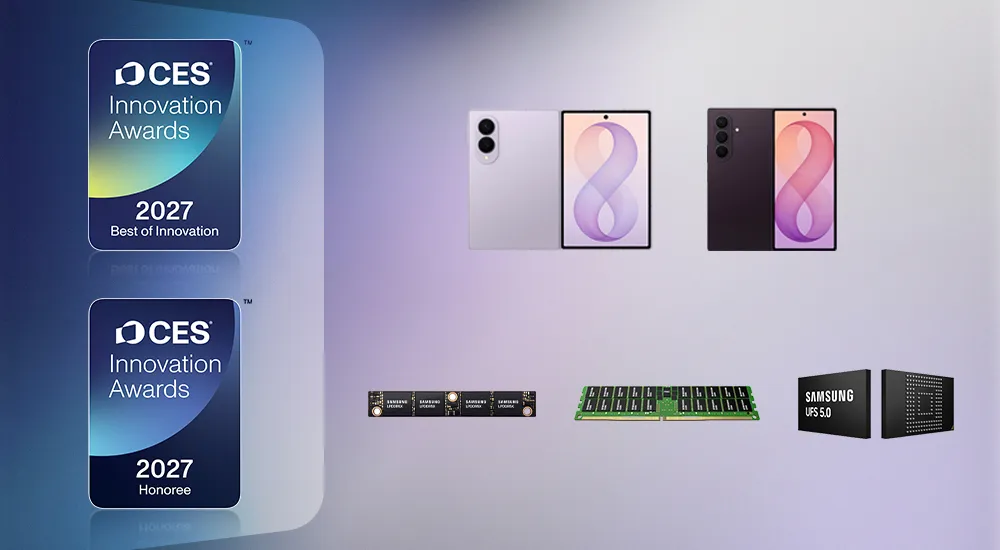
Samsung's 512GB DDR5 RDIMM (1b 32Gb DRAM-based) targets high-performance computing and next-generation data centers. Using 32Gb DRAM, it reaches 512GB with a four-layer stacking structure, versus eight layers in conventional 16Gb DRAM-based modules. That reduces packaging complexity. In a server with 16 memory channels (operating in a one DIMM per channel configuration), 512GB RDIMMs can provide up to 8TB of memory, twice the 4TB maximum with 256GB RDIMMs. They also consume up to 15% less power than conventional 16Gb DRAM-based 512GB RDIMMs. Samsung says this helps cut power and cooling demands and supports generative AI training, machine learning, and enterprise big data analytics, which can reduce TCO (total cost of operation).
The LPDDR5X SOCAMM2 is a compact module for AI servers that pairs low-power mobile DRAM efficiency with high bandwidth. It delivers up to 153.6 GBps, 2.6 times that of conventional DDR5 RDIMMs, with over 70% better energy efficiency. Its low-profile horizontal design saves space and improves airflow. Because the module is detachable, memory can be replaced and capacity upgraded without replacing the motherboard.
UFS 5.0 is billed as the industry's first UFS 5.0 storage solution, designed for on-device AI in smartphones and other mobile devices. It reaches up to 10.8 GBps and doubles the sequential read and write performance of UFS 4.1. A proprietary software algorithm improves random read performance across a large storage area by more than 3.4 times. Samsung says this reduces AI model loading times and improves responsiveness for features like real-time content generation. It comes in 512GB and 1TB capacities.
Samsung’s Galaxy Z Fold8 Ultra and Galaxy Z Fold8, both named CES 2027 Best of Innovation winners, launched in the United States after Samsung’s July 22, 2026, Unpacked event and are currently on sale. Samsung lists starting prices of $2,099.99 for the Galaxy Z Fold8 Ultra and $1,899.99 for the Galaxy Z Fold8; both models are available in 256GB, 512GB and 1TB configurations.