Samsung Brings 5.1 Gbps 5G to Next-Generation Cars
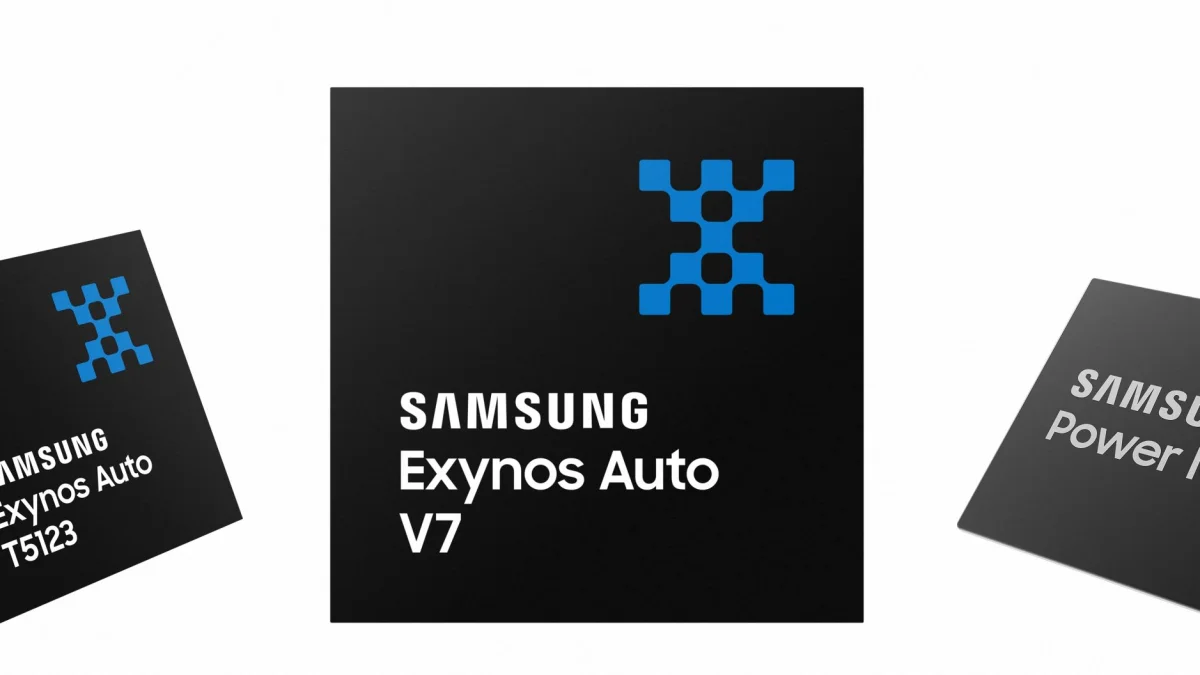
Samsung Electronics has introduced three automotive chip solutions aimed at connected cars: the Exynos Auto T5123 for 5G connectivity, the Exynos Auto V7 for in-vehicle infotainment, and the S2VPS01 power management IC (PMIC) for the Auto V series. The announcement, dated November 29, 2021, positions Samsung to extend its mobile chip expertise into automotive. In the company's words, “With an advanced 5G modem, an AI-enhanced multi-core processor and a market-proven PMIC solution, Samsung is transfusing its expertise in mobile solutions into its automotive lineup and is positioned to expand its presence within the field,” said Jaehong Park, Executive Vice President of System LSI Custom SOC Business at Samsung Electronics.
With an advanced 5G modem, an AI-enhanced multi-core processor and a market-proven PMIC solution, Samsung is transfusing its expertise in mobile solutions into its automotive lineup and is positioned to expand its presence within the field.
The Exynos Auto T5123 is a 3GPP Release 15 telematics control unit built for 5G connectivity in both standalone (SA) and non-standalone (NSA) modes. It supports high-speed download of up to 5.1 gigabits per second (Gbps), which Samsung says delivers essential information to the vehicle in real time and enables services such as high-definition content streaming and video calls on the go.
To handle the large volume of data moving through the 5G modem, the T5123 supports a high-speed PCIe (PCI Express) interface and low-power, high-performance LPDDR4x mobile DRAM. It includes two Cortex-A55 CPU cores and a built-in Global Navigation Satellite System (GNSS), which Samsung says minimizes the need for external ICs and shortens product development time. The chip meets stringent automotive requirements and is qualified to the Automotive Electronics Council's AEC-Q100 standard. Samsung states that the T5123 is in mass production and is delivering 5G-based vehicle communication for the first time in the industry.
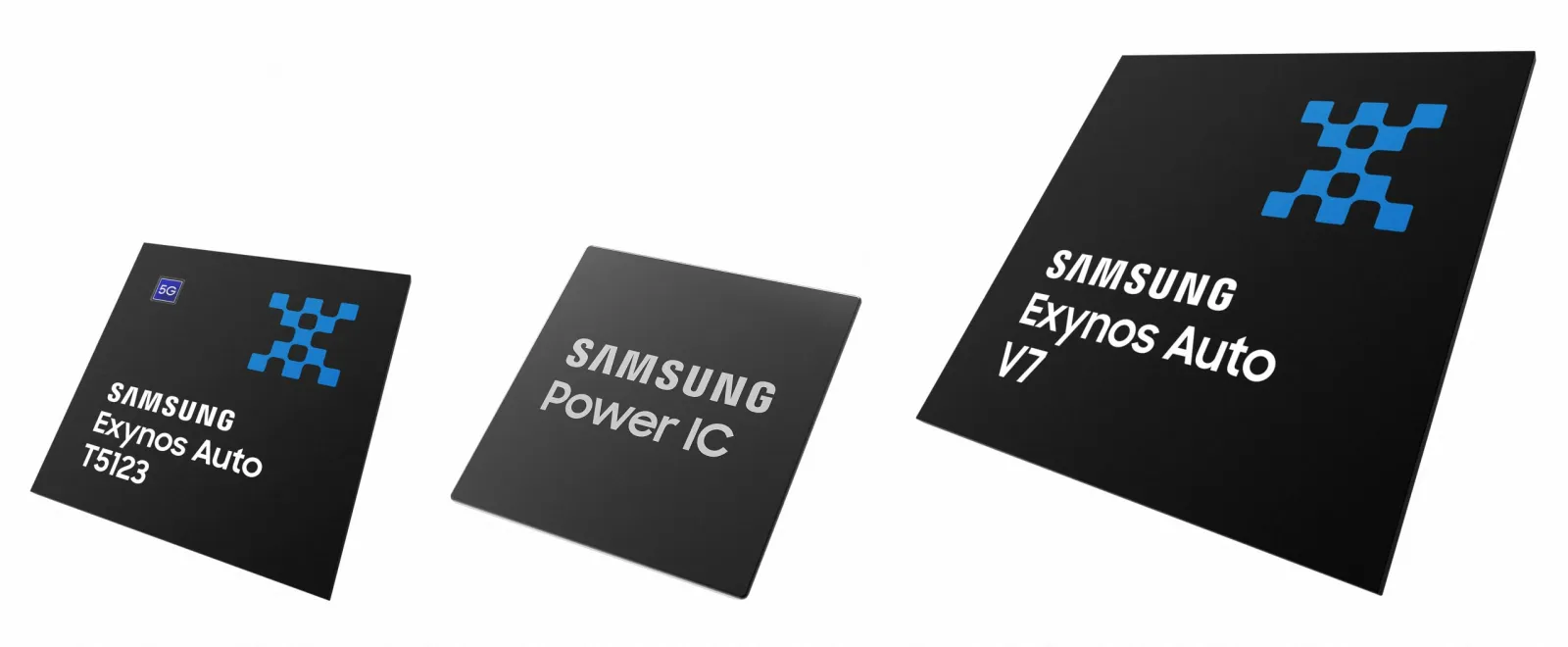
The Exynos Auto V7 is the newest processor in Samsung's automotive lineup, designed for in-vehicle infotainment (IVI) systems. It integrates eight 1.5-gigahertz (GHz) Arm Cortex-A76 CPU cores and 11 Arm Mali G76 GPU cores. The GPU is split into two domains: three cores in a “small” domain for the cluster display and AR-HUD, and eight in a “big” domain for the central information display (CID) and other functions. Samsung says this physical separation lets the GPU support multiple systems simultaneously and keeps one domain from interfering with another. An NPU handles features such as virtual assistance, processing visual and audio data for face, speech, or gesture recognition.
The V7 supports up to four displays and 12 camera inputs for driver and passenger assistance. Its imaging system applies bad pixel correction, dynamic range compression, and geometric distortion correction to produce clean images for surround view and parking assistance. Three HiFi 4 audio processors support in-car entertainment for songs, movies, and games. Memory is up to 32 gigabytes (GB) of LPDDR4x with bandwidth of up to 68.3 gigabytes per second (GB/s).
On security, the V7 includes an isolated security processor for crypto operations and provides a hardware key using either a one-time programmable (OTP) or physical unclonable function (PUF). For functional safety, it complies with ASIL-B requirements for a digital cluster and includes an embedded safety island that detects and manages faults, using a fault management unit (FMU) to maintain a safe state. The V7 is in mass production and is used in Volkswagen's latest In-Car Application-Server (ICAS) 3.1, developed by LG Electronics' VS (Vehicle component Solutions) division, to power its next-generation infotainment system.
The S2VPS01 is a PMIC designed for the Exynos Auto V9 and V7. It is Samsung's first automotive solution produced under ISO 26262 functional safety process certification, which the company acquired in 2019, and it achieved ASIL-B certification in 2021. Under ISO 26262, Automotive Safety Integrity Levels run from A to D, with D the highest. Samsung notes that ASIL-B compliance is becoming a key requirement for automotive OEMs and their Tier 1 suppliers.
The chip regulates and rectifies electrical power flow using triple/dual-phase buck converters, and integrates a low-dropout regulator (LDO) and a real-time clock (RTC) in the package. For protection against harsh thermal and electrical conditions, it includes over-voltage protection (OVP), under-voltage protection (UVP), short circuit protection (SCP), over current protection (OCP), thermal shutdown (TSD), clock monitoring, and output stuck checks.
The Exynos Auto T5123 and Exynos Auto V7 are both described as in mass production, with the V7 already used in Volkswagen's ICAS 3.1 infotainment system. The announcement, dated November 29, 2021, does not state pricing for any of the three products. For more information on Samsung's Exynos products, visit samsung.com/exynos.