Server Consolidation: How AMD EPYC Delivers Efficiency and Future Capacity
Server consolidation is reshaping how IT organizations approach data center economics. By migrating workloads to fewer, more capable systems, enterprises can slash power consumption, free valuable rack space, and cut software licensing costs. But there's a strategic angle often overlooked: the headroom created enables future growth—particularly for AI deployments. AMD EPYC processors are engineered precisely for this challenge.
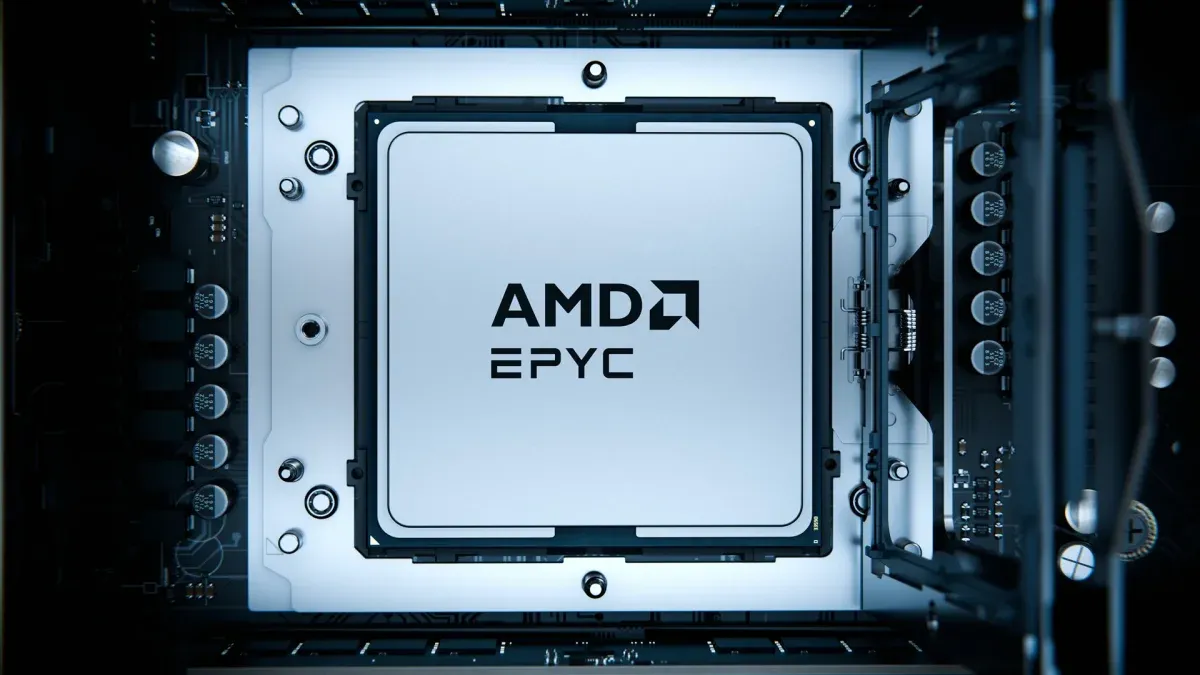
A close-up view of an AMD EPYC processor mounted on a server motherboard, illuminated against a dark background.
Server consolidation is a material project for IT organizations managing data center infrastructure. The objective is straightforward: move workloads from older, less-efficient systems onto fewer, more capable servers without sacrificing performance or disrupting critical applications.
Done well, consolidation improves the economics of the server estate. It can free rack space and power, reduce per-core software licensing costs, and create headroom for future growth—whether the next priority is expanding business applications, analytics, or AI.
AMD EPYC Built for Efficiency
Effective consolidation depends on moving existing workloads onto fewer servers without sacrificing performance or creating unnecessary migration complexity. AMD EPYC processors combine high-core density, strong per-core performance, and energy efficiency on the same x86 architecture enterprises already use. This allows IT teams to pursue greater consolidation without the application validation and migration considerations that can come with moving workloads to Arm-based servers.
5th Gen AMD EPYC CPUs power the most energy-efficient x86 servers available, with a portfolio designed to support consolidation at scale:
High-density configurations (up to 192 cores) for running the maximum number of workloads
High-frequency options (up to 5GHz) for maximizing performance per core and reducing licensing costs
Balanced configurations for workloads requiring both
AMD expects 6th Gen AMD EPYC “Venice” processors will extend this density advantage further, with configurations offering up to 256 cores. That range of options helps organizations consolidate more work while matching compute to workload requirements, and the capacity created can support future needs, including AMD Instinct GPUs for AI inference and training and AMD Pensando networking for predictable data movement.
Consolidation Without Losing Performance
Enterprises can consolidate 100 5- to 7-year-old Intel Xeon Platinum 8280 dual CPU servers into 14 AMD EPYC 9965 CPU-based servers—an 86% reduction—while maintaining the same total performance. This can reduce power use by 69% and lower three-year total cost of ownership by 41%.1
In core terms: 100 older servers with 28 cores and 2 sockets equals 5,600 cores, versus 14 AMD EPYC 9965 servers with 192 cores and 2 sockets equaling 5,376 cores. Overall, this can free substantial data center capacity—yards of rack space and significant kilowatts of power—that can be reclaimed for new workloads within the existing footprint without adding physical infrastructure.
Delivering more work per core translates directly into lower software costs. For software licensed by socket or core—as many virtualization and database packages are—using fewer systems and cores can potentially save millions in license and maintenance fees. When paying per core, getting more work from each one reduces the cost curve. (This benefit does not apply to software licensed by user, device, or other non-core-based models.)
Consolidation in Practice
DNSE Securities, a fast-growing online stock brokerage in Vietnam, needed cloud-like density and performance but had to keep infrastructure on premises due to regulatory requirements. Its existing environment could not deliver the consolidation needed to grow.
After benchmarking AMD and Intel systems, DNSE deployed 3rd and 4th Gen AMD EPYC CPUs across its data center. It halved its number of racks and reduced power consumption from 16–17 kilowatts per rack to 7–9 kW per rack.
Today, 90% of DNSE's workloads run on AMD EPYC CPUs, mixing high-frequency processors for latency-sensitive trading systems with high-core-count processors for mixed containerized workloads. That flexibility—choosing the right CPU for the right job—lets DNSE scale without overprovisioning.
AMD EPYC CPU-powered servers will enable us to keep building infrastructure and running our software how we run it right now, but at a much bigger scale.
Creating Headroom for AI
Across industries, the immediate value is measurable: IT can support the business with fewer servers and racks, lower power use, and reduced software licensing costs. But the benefits extend further. Running existing business applications more efficiently can open power, space, and cooling capacity for new infrastructure.
For agentic AI, that headroom matters across the stack. Every agent action can trigger database queries, API calls, token generation, and tool execution. Consolidating existing workloads onto fewer, more efficient servers can help create capacity to support that additional demand alongside core business applications.
This flexibility becomes even more important as enterprise AI increasingly spans a distributed environment of frontier models, cloud services, on-premises infrastructure, and AI-enabled clients. Different workloads may be best suited to different models and locations based on complexity, data sensitivity, latency, and cost.
For organizations adding AI, that may mean room to deploy accelerators within current data center limits. More broadly, it gives IT teams the flexibility to expand incrementally and match processors, accelerators, and models to the work they perform best—rather than rebuilding around one model or workload.
The CIO Imperative
Server consolidation may not be the highest-profile item on the CIO agenda, but it is a material, measurable project. Success can be tracked in server count, rack space, power use, licensing spend, and total cost of ownership.
With AMD EPYC server CPUs, IT organizations can pursue those goals without sacrificing performance or forcing one configuration across every workload. The result is a more efficient server estate today and more headroom for whatever the business needs next.
AMD EPYC 9965 Specifications
The EPYC 9965 has 192 cores, 384 threads, a maximum boost clock of up to 3.7 GHz, a 3.35 GHz all-core boost speed, a 2.25 GHz base clock, 384 MB of cache, a 500 W default TDP, a configurable 450–500 W TDP range, SP5 platform support, 1P/2P socket support, 128 lanes of PCIe 5.0, 12 DDR5 memory channels, support for memory speeds up to 6400 MT/s, and up to 614 GB/s of per-socket memory bandwidth, according to AMD.