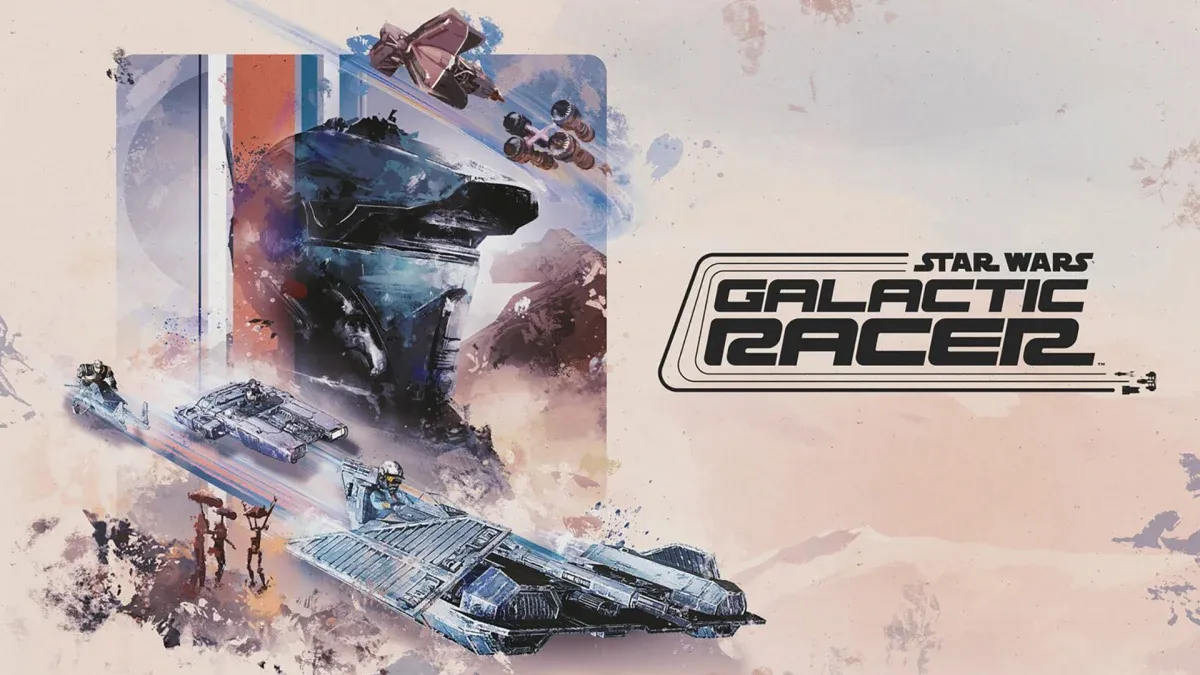
A dynamic illustration of Star Wars vehicles and characters racing across a desert landscape, with the “Galactic Racer” logo prominently displayed.
Three corners from the finish line, another racer shunts your repulsorcraft into an adjacent boulder, sending you careening into the toxic wastes of Sentinel I. The vehicle you spent 4 tours and 23 races tuning is now scattered across the track. Your League Token is forfeit. The tour is over.
These are the moments that define your journey to become Champion of the Galactic League in STAR WARS: Galactic Racer, available today for Xbox Series X|S.
We've got a history of trying to make failure fun. Failure can be this big, spectacular, exciting, interesting and rewarding experience in the game. Our wreck-out system is meant to be the ethos of how Fuse approach game making. Crashing isn't just a big spectacle; it has consequence as well as mechanical rewards so you can learn something for your next run.
Failure is fuel, which is where our runs-based mechanic comes into play. It's the opportunity to try again, and when you get the right combination of builds, parts and upgrades, failure makes winning feel hard earned but so much more rewarding and creates a powerful and unique player story.
In STAR WARS: Galactic Racer, player persistence is key. Crimmins explains Fuse's approach to the runs-based mechanic: “For us, runs-based is a replayable loop that allows you to experiment with a new way to play every time, see how far you get with it, and if you fail, you still get some great rewards to go again so you can try with a new combination of parts and abilities.”
The process begins with choosing a vehicle—a skim speeder, speeder bike, or landspeeder, each with slightly different playstyles and attributes. Next, players pick a Racer Style, which provides a baseline direction for the build, such as an afterburner or cooled build. Then they select abilities, parts, and upgrades after each race.
Performance in races determines financial rewards that players spend at shops between planets. Rewards are random, introducing an element of luck, but most will synergize with existing builds. Winning the league is the goal, but the path to success is filled with challenges, rivals, and events. Crash too many times and you “wreck out”—lose a League Token and start from the beginning of that tour.
Failure is mechanically central to the game. “You have a certain number of crashes that you're allowed to do in any race,” Crimmins explains. “If you use all your crashes, then you'll wreck out and have to start from the beginning of that tour. Crucially, we wanted there to be an element of consequence in the gameplay. Your decisions matter across every part of the game, so you need some sort of finite failure state for your decisions to matter. Every corner matters, every interaction with another racer matters. It forces you to think about what choices you make and what you're doing, rather than driving with abandon.”
Player choice defines the satisfaction of runs-based gameplay. “If you think about playing in its most base form, it isn't someone tells you what to do then you do it,” Crimmins says. “That's a job, that's instruction. Instead, we provide a play space full of fun things. Play is the choice to arrange them in the way that you want, and creating your own moments and journeys. The power of a good player story is the absolute power of play in general.”
Two progression routes exist within each run. The first is stat build-up, where players gain temporary stats like cornering, resilience, ramjet, and afterburner, allowing them to dial into their playstyle. The second is parts combination—players can install up to five parts with different rarities that synergize in vastly different ways. Some parts even develop faults that change builds further. “The combinations in the parts system is so vast, I'm not even sure we've seen every single combination yet!” Crimmins notes.
Permanent progression exists outside each tour. Players can invest in one of their vehicle types with permanent stats, unlock new parts pools by beating tours, gain access to new “favors” that modify rules for the next run, and upgrade Racer Styles to unlock different playstyles.
These features carry into multiplayer, where players pick a Racer Style, upgrade their vehicle, and gamble it all on a final knockout event. Winning nets vast amounts of XP to unlock new characters and customization. Players gain XP even if their run falters by voting on which racer they think will win the final race.
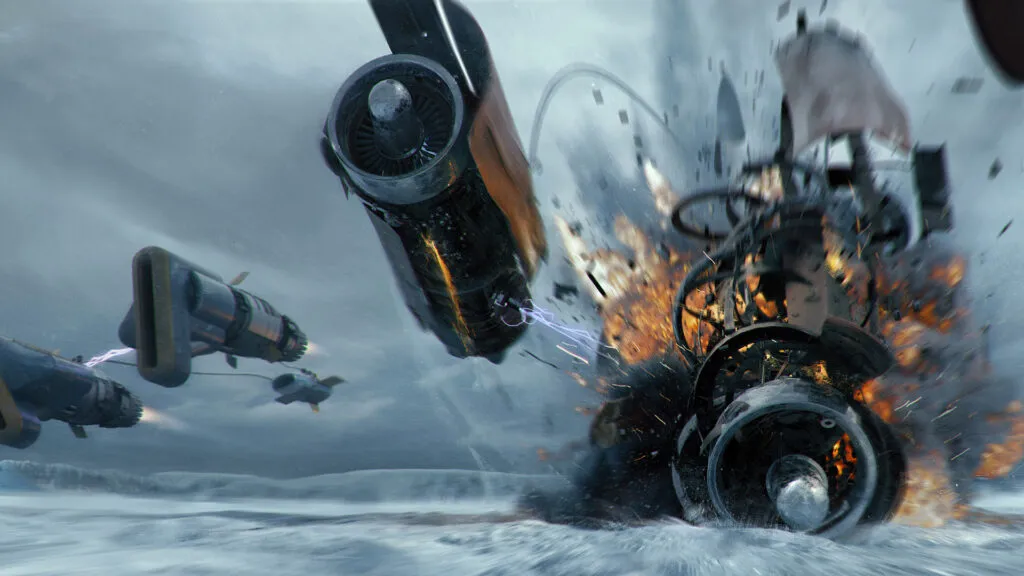
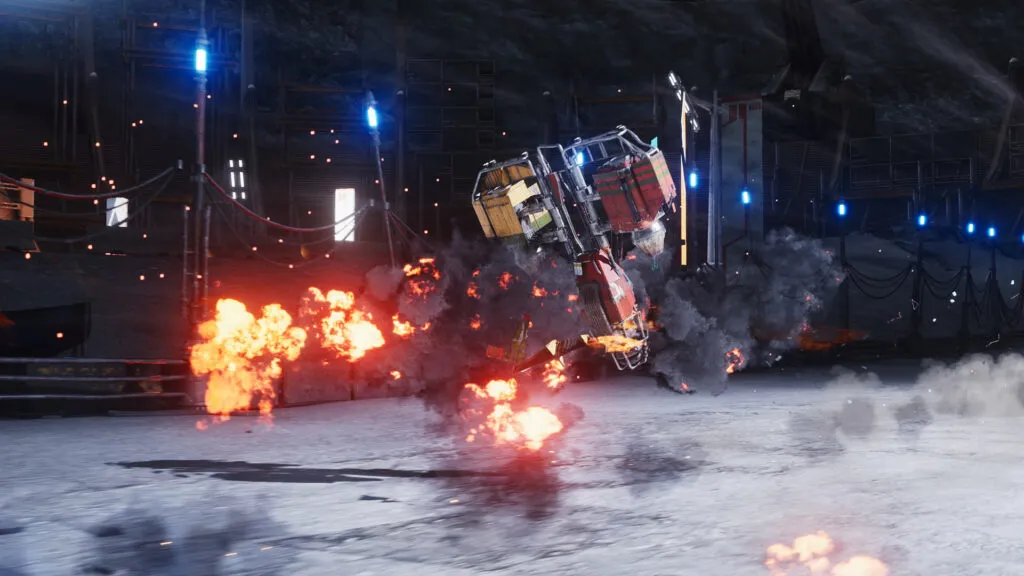
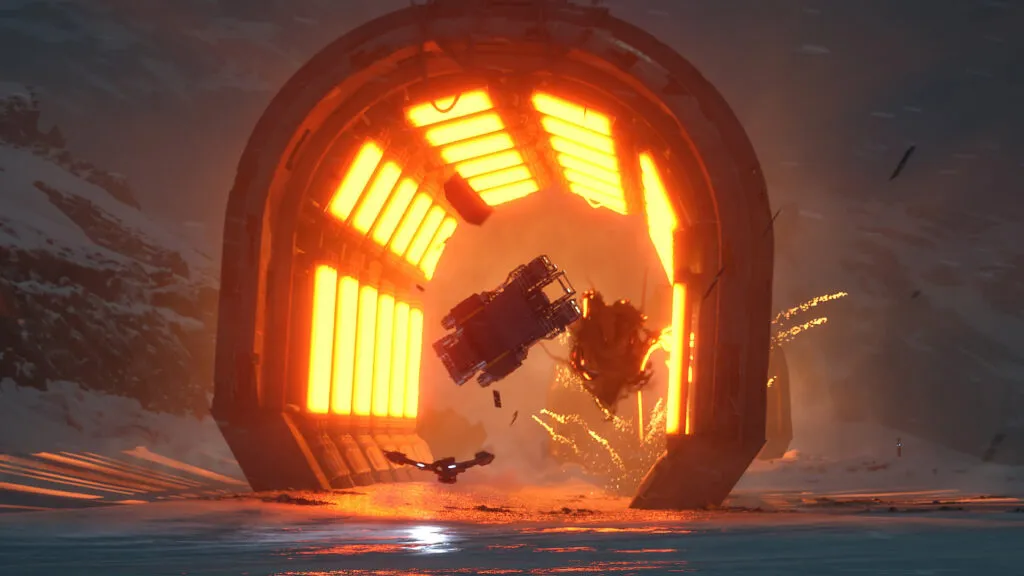
The spectacle of crashes—and their consequence—makes the racing dramatic to watch. Uphill emphasizes the importance of making crashes feel procedural rather than scripted. “Having such a breadth of player choice and decisions meant that they'll see crashes a lot. That's why it was so important to us to not simply use pre-canned animations for the crashes. We wanted to generate a system that made every shot feel cinematic but was also procedural, so every time a crash happens you see it differently.”
Four vehicle types behave completely differently. The speeder bike, being smaller, rolls; podracers have separate engine units from their cockpit, each with its own logic. “We needed a crash system that worked across all of them, and made sure every crash told a story instead of just blowing up,” Uphill says. “The speeder bike hitting a tree on Endor is iconic to ‘STAR WARS: Episode VI – Return of the Jedi,' so that stays an instant hit. Bigger vehicles roll and come apart over time, extending the spectacle and creating impact.”
Pacing was a critical constraint. The crash sequences in “STAR WARS: Episode I – The Phantom Menace” stretch to thirty seconds. “We've designed our maximum to be up to eight seconds,” Uphill laughs. “That's the real challenge! If I had it my way, they would be much longer. But the team was right. Longer cinematics slowed gameplay down too much. But that was a creative constraint: How do you build the vehicles and the camera system to make the most of eight seconds, cinematically and procedurally, when you don't have long to play with?”
The camera system presented the other half of the problem. A poorly framed crash loses spectacle and becomes visual noise. “The camera system might seem simple, but they're incredibly hard,” Uphill explains. “A crash is instantaneous and the system has to work out where the vehicle is, where it's heading, how fast, what's blocking the shot, all before it can even decide how to frame it. The whole sequence has to feel believable and weighted, or it falls apart.”
Weight was essential—without it, vehicles feel like toys bouncing down the track. With four vehicle types of different sizes and masses, achieving consistent weight across all of them proved genuinely difficult. “Sometimes they didn't land… they bounced,” Uphill recalls.
“The answer ended up being a mixture of iteration, as well as creating a system that allows the camera to intelligently read the environment,” Uphill continues. “At the moment of the crash, we introduce some unique geometry to the scene that ensures the camera is always placed in the optimal position, whilst also triggering the right VFX, audio and various other elements to make the crashes immersive and satisfying to watch.”
“It's kind of a modern marvel when you think about it,” adds Crimmins. “If you were to film that for a movie sequence, you're talking three to six months of planning and a day of shooting to get one fixed camera where you knew everything that was about to happen. This does it in milliseconds.”
The result is a crash that feels earned and unique, not scripted—meaningful systems paired with meticulous craft. The systems give the crash weight, the craft gives it meaning. Put those together and a racing game stops being about who crosses the line first, and instead becomes about everything you're willing to risk to get there.
STAR WARS: Galactic Racer launched on Oct. 6, 2026, for PlayStation 5, and PC. The standard edition is listed at $59.99, while the Deluxe Edition is $79.99; physical PS5 copies are listed at IGN as in stock at Target, while Best Buy reports pickup unavailable.
| Model | Price | Where to buy | As-of date |
|---|---|---|---|
| Standard Edition — PS5 | $59.99 | PlayStation Store; Target; Best Buy | Oct. 2026 |
| Standard Edition — Xbox Series X|S | $59.99 | Xbox Store; Amazon; Best Buy; GameStop; Target | Oct. 2026 |
| Standard Edition — PC | $59.99 | Steam; Epic Games Store | Oct. 2026 |
| Deluxe Edition — PS5 | $79.99 | PlayStation Store; Amazon; Best Buy; GameStop; Target | Oct. 2026 |
| Deluxe Edition — Xbox Series X|S | $79.99 | Xbox Store; Amazon; Best Buy; GameStop | Oct. 2026 |
| Deluxe Edition — PC | $79.99 | Steam; Epic Games Store | Oct. 2026 |
Nobody has commented on this yet.
💬 Be the first to comment