NVIDIA RTX Spark delivers 4.6x coding agent performance
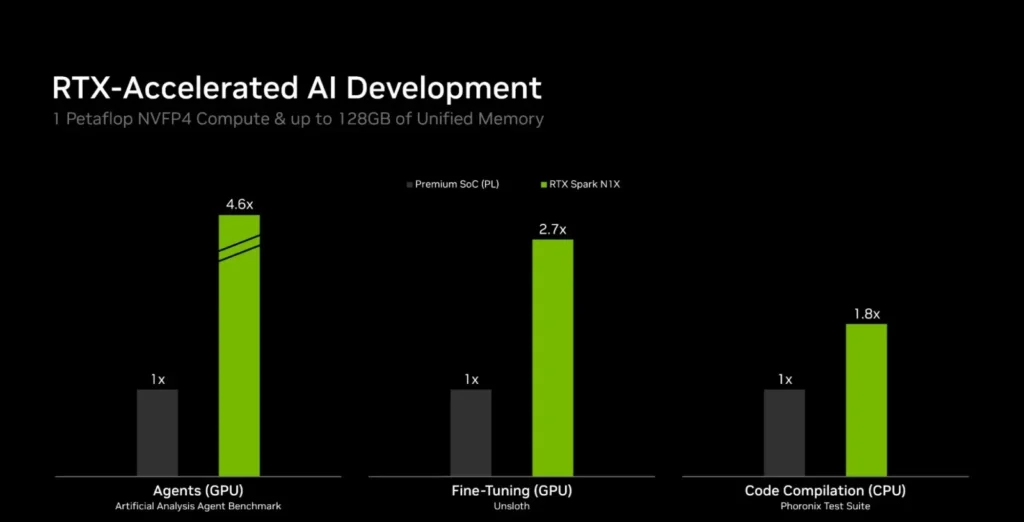
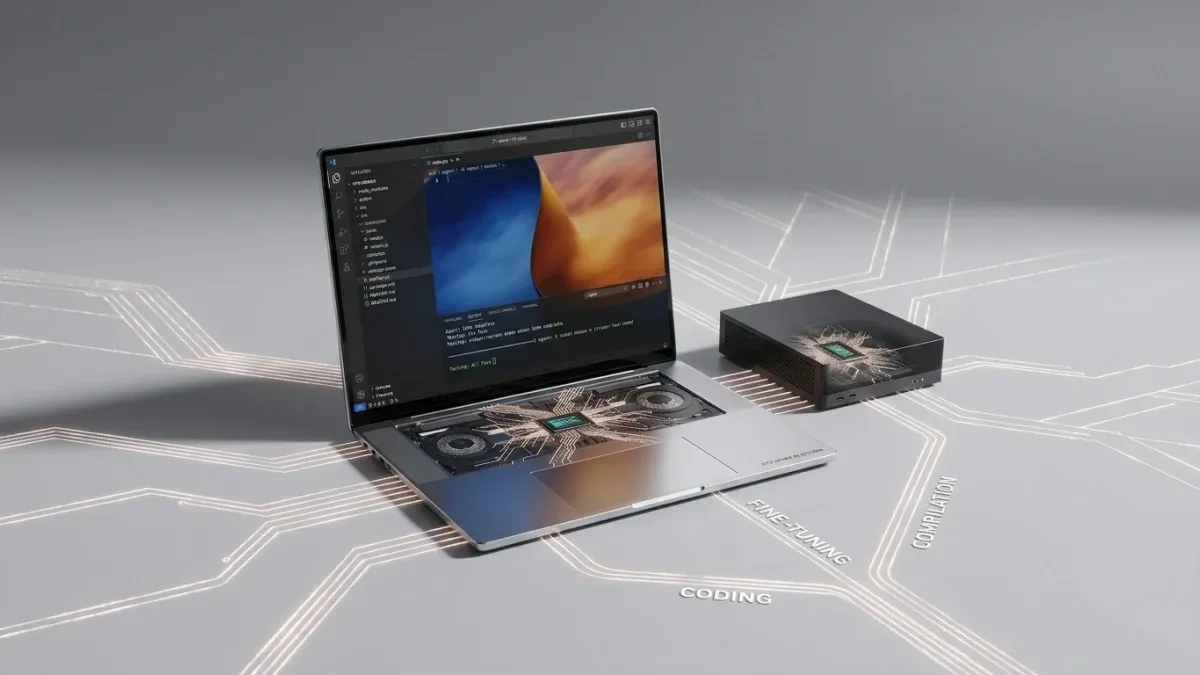
NVIDIA's RTX Spark is a laptop and compact desktop platform built for AI development. Its GB10 system-on-a-chip and large unified memory let developers run local coding agents, access AI frameworks, and code, test, and deploy on a single PC. The workflow that developers now split across a laptop, a cloud model API, and a cloud VM can, according to NVIDIA, be completed on one machine. Compared with Intel's Panther Lake 12Xe, NVIDIA says RTX Spark delivers 4.6x performance on coding agents, 2.7x on fine-tuning, and 1.8x on code compilation.
AI agents are changing how software gets built. Developers have moved from writing every line by hand to directing agents that write most of the code. NVIDIA argues that development has shifted from a CPU-bound workload, where the processor mostly determined performance, to a GPU-bound one. Developers now need inference to run coding agents and test apps, fine-tuning and training for models, and still some compilation.
RTX Spark pairs the NVIDIA Grace CPU with a Blackwell GPU, which NVIDIA says supplies the compute for all three tasks. Developers can choose their OS. They can work in Windows, which includes the new Windows Developer Config, developed with Microsoft. That config installs the top development frameworks, mutes notifications, enhances the terminal, and can move the taskbar to the side. Alternatively, they can work in Windows Subsystem for Linux, which gives access to the same environment and dependencies they will use when deploying to the cloud. Either way, NVIDIA says, work stays in the target OS without code migrations.
Because RTX Spark carries an NVIDIA GPU, code tested locally can move to the largest local AI installed base, which NVIDIA puts at 150 million RTX PCs, and to virtually all clouds that run on NVIDIA GPUs.
With up to 128GB of unified memory and 1 petaflop of FP4 AI compute, developers can run coding models locally, including Qwen 3.8 Flash Next. NVIDIA says this reduces cloud coding agent token consumption.
NVIDIA's benchmark comparison, normalized to Intel Core Ultra X9 388H at 1.0, used the following tests: AA-AgentPerf-local with Qwen3.8-27B for coding agents, Unsloth LoRA with Llama-3.1-8B for fine-tuning, and Linux kernel compilation using the Phoronix Test Suite.
| Workload | Benchmark | RTX Spark vs. Intel Panther Lake 12Xe |
|---|---|---|
| Coding agents | AA-AgentPerf-local with Qwen3.8-27B | 4.6x |
| Fine-tuning | Unsloth LoRA with Llama-3.1-8B | 2.7x |
| Code compilation | Linux kernel compilation using the Phoronix Test Suite | 1.8x |
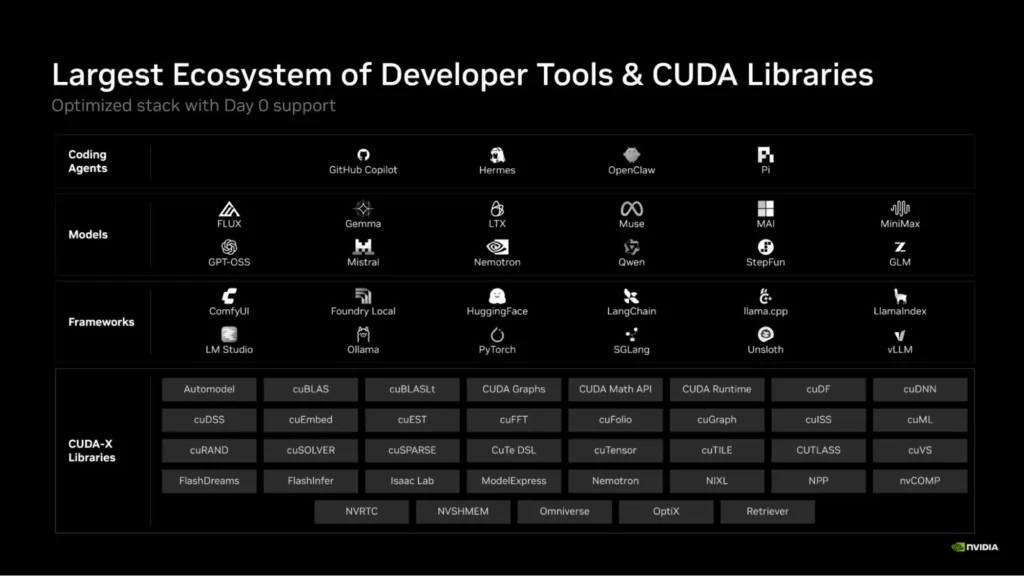
NVIDIA also points to ecosystem work with Microsoft. The community is releasing the first PyTorch-CUDA build, the first Python release that is native by default with Python 3.15, over 2,000 ready-to-use Conda packages, and Arm-compatible versions for more than 97% of the top 15,000 Python packages. NVIDIA adds that new tools and frameworks typically work on NVIDIA from day one, while other hardware support follows weeks later. CUDA-X libraries include FlashInfer for LLM acceleration and NVIDIA NeMo tools for AI model development. The NVIDIA Skills repository teaches agents how to use CUDA-X libraries, so developers can build GPU-accelerated applications without deep CUDA familiarity.
NVIDIA says it worked with GitHub Copilot, Pi, Hermes, and OpenClaw to improve these agents and make them easier to use. The improvements include seamless deployment of local models with optimized recipes; enhanced security through NVIDIA OpenShell and/or Microsoft Execution Containers, which provide OS-level sandboxing; and hybrid prompt routers that send prompts to local models when they are good enough and escalate to cloud models when needed, reducing token consumption. GitHub Copilot now supports local AI through Windows ML, which works with llama.cpp as a backend. The HydraFusion prompt router now also supports local models, and the new MAI 1.1 Coding Flash model can run locally on RTX Spark.
Pi, an open-source coding agent with a lightweight terminal interface, is also optimized for the platform. JetBrains has added native support for Junie Local on RTX Spark. Junie Local reads code, edits files, and runs tests, with the model and code staying on the machine. It sizes its context window to the GPU's available memory, so unified memory lets it keep more code, tool output, and conversation history in context.
NVIDIA also introduced Nemotron 3.5 Bolt 74B-A9B 24GB, an LLM built for running local agents on RTX Spark. It is a 74B-parameter mixture-of-experts model with 9B active parameters, packed into 24GB using 2-bit quantization and quantization-aware training to retain quality. NVIDIA says it balances speed and intelligence, running faster than most popular dense models while being smarter than most popular MoE models with a similar memory footprint. It runs at launch through llama.cpp, vLLM, Ollama, Unsloth, and LM Studio, and agents such as Hermes and OpenClaw can access it directly. Like other Nemotron models, Bolt 74B is fully open source, including training data, weights, and recipes.
NVIDIA also highlights decision models, which give agents a near-instant way to choose the next action, such as classifying requests, without lengthy reasoning loops. NVIDIA says they can work up to 200x faster than traditional agents. Decision models are supported in llama.cpp and Unsloth on RTX Spark and GeForce RTX GPUs.
For media workloads, the NVIDIA AI for Media SDKs now support RTX Spark. The Python wheel includes video super resolution, frame generation, and TrueHDR, and is available on PyPI. C++ SDKs are on NGC for RTX Spark and Windows on Arm.
RTX Spark is available now in laptops. Small form factor desktops, designed for always-on, 24×7 agents, arrive in November. NVIDIA did not state pricing in the announcement. Developers can find systems and purchasing options through the NVIDIA RTX Spark marketplace page. NVIDIA's AI Development playbook covers configuring Windows, setting up an agent, and connecting NVIDIA Skills, and its app-porting resources explain how to move existing applications to Windows on Arm.