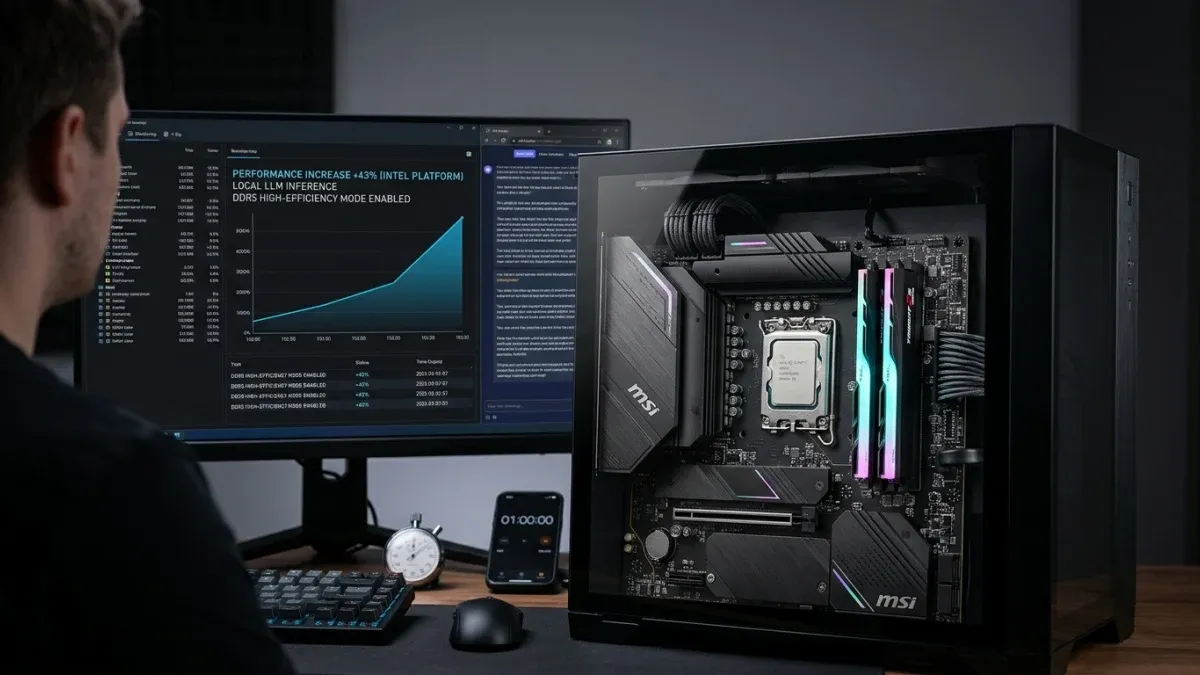
A person views a monitor displaying performance graphs next to an open MSI PC case with RGB lighting and components.
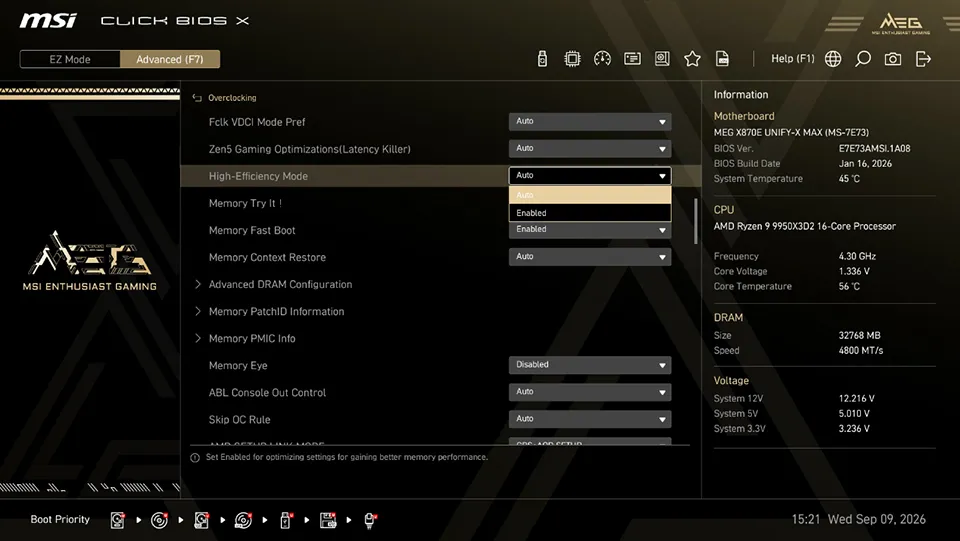
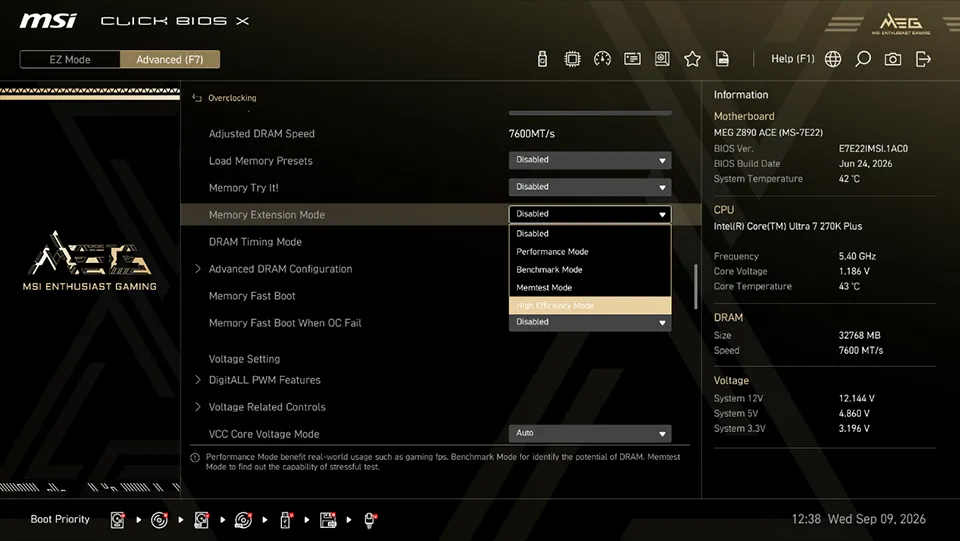
Computing power on AI platforms has become increasingly critical. While upgrading hardware delivers noticeable AI performance gains, it can be costly. MSI conducted hands-on benchmark tests showing that simply tweaking High-Efficiency Mode—a built-in memory overclocking option in MSI BIOS—can optimize DDR5 memory performance and significantly accelerate Large Language Model (LLM) performance without purchasing additional hardware.
Using the AMD Ryzen 9 9950X3D2 processor, benchmark results show that overclocking DDR5 memory to 8000 MT/s and enabling High-Efficiency Mode improves AI operational performance by up to 32%.
Throughput (Tokens/s): When tested across different overclocking modes to measure tokens (the smallest text unit processed by AI) produced per second—higher values indicate faster AI generation speed—overclocking RAM to 8000 MT/s on the RTX 5080 16G and RTX 5070 12G boosted performance by 21.4%. Enabling High-Efficiency Mode further enhanced performance, yielding a total increase of 32%. The RTX 5070 Ti 16G improved by 17.6% after overclocking to 8000 MT/s, with High-Efficiency Mode enabled delivering an overall 26.8% gain.
TTFT (Time to First Token): Measuring the duration between submitting a prompt and generating the first token—where shorter durations indicate higher efficiency—overclocking to 8000 MT/s and enabling High-Efficiency Mode effectively reduced wait times. The RTX 5080 16G saw a 6.3% decrease in wait time at 8000 MT/s, with a 12.7% latency reduction after enabling High-Efficiency Mode. The RTX 5060 Ti 16G showed an even larger 14.5% reduction.
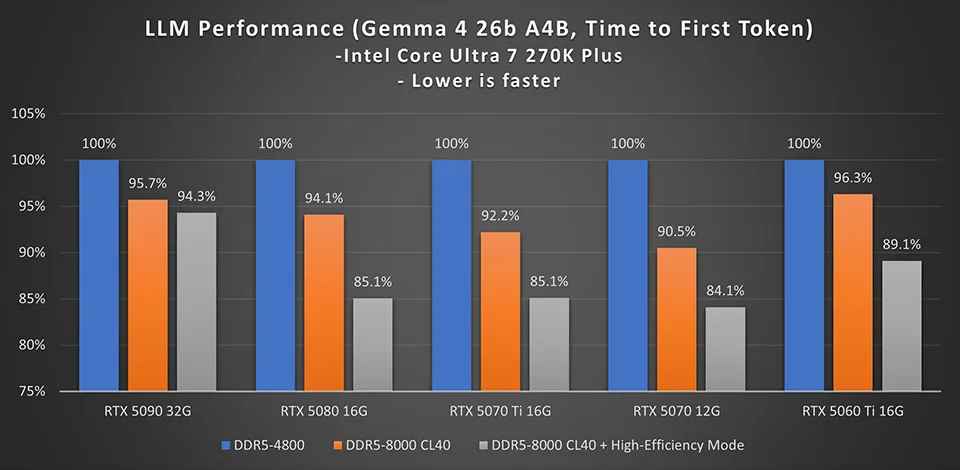
On the Intel platform using the Intel Core Ultra 7 270K Plus processor, performance improvements from enabling High-Efficiency Mode were even more pronounced, delivering gains of up to 43%.
Throughput (Tokens/s): Overclocking to 8000 MT/s increased performance on the RTX 5080 16G and RTX 5070 Ti 16G by 25.7% and 24.9%, respectively. After enabling High-Efficiency Mode, their Tokens/s improved by 43.5% and 42.4% over stock defaults. The RTX 5070 12G, which initially gained 17.8% from overclocking alone, exceeded 30% performance improvement once High-Efficiency Mode was enabled, demonstrating that the feature allows the system's full potential to be effectively realized.
TTFT (Time to First Token): All tested GPUs saw less than 10% latency reduction with the 8000 MT/s memory overclock alone. Combined with High-Efficiency Mode, TTFT improved across the board: the RTX 5070 12G showed the most prominent result with a 15.9% reduction, while the RTX 5080 16G and RTX 5070 Ti 16G also delivered solid improvements.
Many users retain stock BIOS configurations after building a PC. While default settings are sufficient for everyday tasks, simple adjustments can unlock substantial untapped performance. Through extensive internal validation, MSI provides streamlined BIOS presets that allow users to fine-tune memory profiles easily while maintaining system stability. Enabling MSI High-Efficiency Mode is an effective, zero-cost optimization available with just a few clicks in the BIOS.
Benchmarks used the LLM model Gemma 4 26B A4B loaded via LM Studio with a context length of 8192 and default GPU offload settings (RTX 5090 = 30, others = 19). The test prompt requested a website summary. Three test profiles were configured: (1) Default settings (RAM: 4800 MT/s), (2) RAM overclocked to 8000 MT/s, and (3) RAM overclocked to 8000 MT/s with High-Efficiency Mode enabled (AMD platform set to Tighter mode). Tokens/s (TPS) and Time to First Token (TTFT) were recorded as reported by LM Studio.
Hardware Configuration: