Google's Carbon ranks #1 at 2X+ lower cost
Google has made Gemini 4 Carbon available to developers, enterprises, scientists, and consumers. Carbon is Google's strongest model, with frontier performance in cybersecurity capabilities and long-horizon agentic workflows across complex knowledge work, software engineering, and scientific reasoning. It ranks #1 on CursorBench 4.0, Perplexity's WANDR, and Zapier's AutomationBench at more than 2X lower cost per task compared to the next best external model.
Two weeks ago, Google released Carbon to a set of cybersecurity defenders via its Fairwind Program. Carbon follows the recent launch of Gemini 4 Argon and pushes the frontier even further. Argon remains the ideal choice for the majority of software engineering and knowledge work. Carbon is built for tasks that test the limits of a model's intelligence, like complex, multi-step coding and debugging and open-ended scientific research and discovery. It uses more tokens than Argon to explore thoroughly, reason deeply, and run extended verification loops.
Across independent benchmarks designed to test model performance in real workflows, Google says Carbon pairs frontier accuracy with practical production economics.
To put Carbon to work on larger and more complex projects, Google is previewing /swarm in Google Antigravity. It turns a single prompt into a coordinated team of agents that can be tracked in real time. Developers can assign Carbon to roles that demand the deepest reasoning, like architectural design, coordination, and auditing. They can pair it with faster, lighter models across parallel isolated workspaces and adversarial verifiers that test every change.
Across legal, finance, and enterprise operations, Carbon combines frontier visual understanding, reasoning, and exhaustive retrieval to synthesize grounded insights across large sets of dense documents and data. It follows strict schemas and formatting to generate polished and precise spreadsheets, presentations, and reports.
Google says existing benchmarks don't adequately capture how agents reason natively over dense files with charts, images, blueprints, schematics, and tables. It partnered with Artificial Analysis to launch the new Multimodal Knowledge Agent (MKA) benchmark, which tests a model's multimodal performance in agentic workflows. Carbon ranks #2 while being more than 6X lower in average cost per task compared to the top performing model.
In pre-release evaluations, Carbon matched the performance of the best model tested on deep financial research on Hebbia's E2E Financial Agentic evaluation. It also ranked at the top out of 23 frontier model configurations on Balyasny Asset Management's General Financial Intelligence benchmark. That benchmark spans legal expertise, agentic tool use and execution, coding and data engineering, and perception and context understanding.
Carbon performs exceptionally well on engineering tasks that require multi-agent collaboration, like multi-package migrations, cross-subsystem root-cause investigations, and complex architectural redesigns. For web app development, it runs build-and-verify loops, recovers from errors, and checks both its code and the rendered UI to produce complete, working applications. Stronger visual design, spatial reasoning, and attention to environmental detail also carry over to 3D game development and creative coding.
Gemini 4 Carbon for cyber delivers Google's strongest cybersecurity capabilities to date. When accessed through the Fairwind Program, Carbon leads on key benchmarks across finding (SEC-bench Pro), exploiting (ExploitGym), and patching (CWE-bench v1) vulnerabilities. That means inspecting software, tracing how flaws can be chained together across systems, and generating verified root-cause patches.
Early results from testers inside and outside Google include:
Carbon shows strongly improved performance in reasoning across physics, math, and life sciences, synthesizing experimental data, testing hypotheses, and reasoning through multi-step domain problems. For drug toxicity research company Axiom Bio, Carbon is now the leading model in performance for translational science, finding novel mechanisms of toxicity the company hadn't found previously. Axiom is moving its production scientific analyses and agents to both Carbon and Argon.
Researchers across Google have been using Carbon in Google Antigravity:
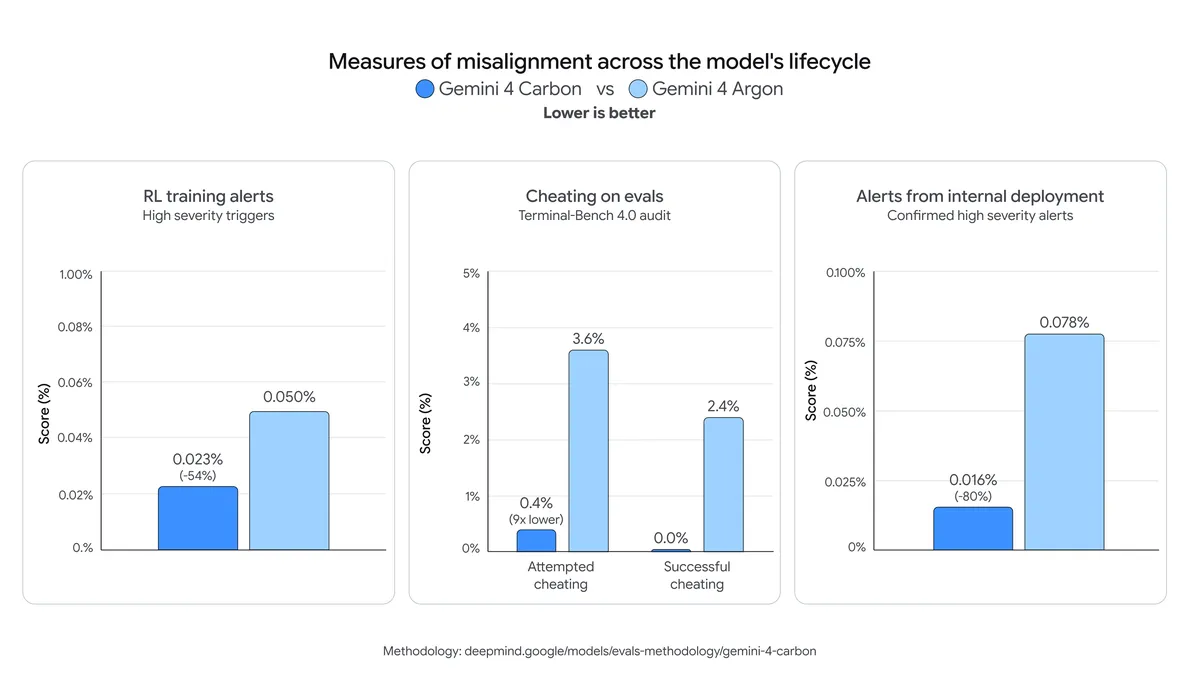
Because Carbon introduces stronger cyber capabilities, Google built on Argon's safety and security stack to fortify robustness to misuse and prompt injection. In simulated cyberattack testing environments seeded with ExploitBench and CyScenarioBench, Carbon blocked 99% of attack trajectories from Google's adaptive red-teaming agent. The safeguards lowered the per-attempt breach rate to 0.8%, down from 3.1% on Argon. In Gray Swan's testing, they lowered the automated cyberattack query success rate to 2.17%, compared to 9.86% on Argon. External testing by Trajectory Labs found zero new universal jailbreaks across 132 hours and over 13,000 requests.
| Metric | Carbon | Argon |
|---|---|---|
| Per-attempt breach rate | 0.8% | 3.1% |
| Automated cyberattack query success rate (Gray Swan's testing) | 2.17% | 9.86% |
/swarm in Antigravity (preview): one prompt becomes a coordinated, trackable team of agents, with Carbon handling architecture, coordination, and auditing.Gemini 4 Carbon is available via the API in Google AI Studio and Gemini for business for all paying developers and enterprises. It costs the same introductory price as Gemini 4 Argon: $2 per million input tokens and $10 per million output tokens. It is also rolling out to all Google AI Ultra subscribers in Google Antigravity, the Gemini app, and AI Mode in Search.
| Token type | Introductory price |
|---|---|
| Input tokens | $2 per million |
| Output tokens | $10 per million |
Four weeks ago, Google opened applications to give 10,000 scientists access to Argon in Google Antigravity free of charge for six months, and it has onboarded thousands already. Google is now expanding access to Carbon for current and future participants. The program will continue providing access to the latest frontier models as they become available. Applications remain open, and onboarding continues on a weekly rolling basis, subject to eligibility, capacity, and selection.