Tag: claude

Database-checked rewards lifted 27B agent's dependable tasks 2.8x

Database-checked rewards lifted 27B agent’s dependable tasks 2.8x

Microsoft and Hugging Face's ThinkingBox-Training, now on GitHub, uses the same executable database checks that grade agents as training rewards. In one run, Qwen3.8-27B's average success rose from 51.70% to 60.78% after 50 GRPO steps, and tasks it completed correctly on all twenty attempts rose from 38 to 107. This is a follow-up to the team's first post on ThinkingBox, a benchmark that tests whether an agent's work actually changed the database it was supposed to change. In that earlier post, a model closed a customer's ticket as resolved while the carrier exception behind it was still...

Continue reading

Anthropic invests $100 million to train 10,000 engineers

Anthropic invests $100 million to train 10,000 engineers

Anthropic is investing $100 million in Claude Frontier Academy to train 10,000 Frontier Deployed Engineers by the end of 2027. Cohorts from Accenture, Bain, CBA, Deloitte, McKinsey, Morgan Stanley and Novo Nordisk are already underway. The effort addresses the enterprise AI talent gap, and the announcement pairs it with two smaller science programs. Three Programs in One Announcement The engineering academy is the largest of the three. It aims to build a pool of Frontier Deployed Engineers, with the goal of 10,000 trained by the end of 2027. On the science side, Anthropic says that starting...

Continue reading

Agents recall past sessions 8x cheaper than handoffs

Agents recall past sessions 8x cheaper than handoffs

Coding agents forget everything when a session ends, so each new agent on each new machine starts from zero. Hugging Face's funes is an open-source memory layer that indexes the sessions already on your machine and lets Claude Code, Codex, pi, and Hermes recall past decisions, rationale, and dead ends. In the team's benchmark, recall was 8x cheaper than a written handoff on one task and 4x cheaper on the other. The article builds on an earlier argument that coding agents already produce the record we keep losing: as they search, try approaches, hit errors, and change direction, they leave a...

Continue reading

Ollama offers Reflection's Beam free for a limited time

Ollama offers Reflection’s Beam free for a limited time

Ollama is a day-zero partner, rolling out Beam for free for a limited time. In collaboration with Reflection, Ollama's Beam endpoint runs with full zero data retention (ZDR). You can reach Beam through Ollama Cloud, where you can run supported models from your apps or terminal without downloading models or managing local inference. Beam is a mixture-of-experts model with approximately 501 billion total parameters and 23 billion active parameters per token. It is designed for software engineering, reasoning, and long-horizon agentic tasks. Its text-in, text-out design targets workflows that...

Continue reading

Lovable Apps Gain Voice, Reasoning, and Video Generation

Lovable Apps Gain Voice, Reasoning, and Video Generation

Lovable has added new AI models and tools that let builders create apps for tutoring, research, support triage, and video creation, all without leaving the platform. The update brings GPT-Live from OpenAI, the latest Claude models from Anthropic, Gemini 4 Argon, Gemini Omni, and Lyria from Google, and data tools from Perplexity, Firecrawl, Parallel, and Jev by Typesafe AI. Real-time voice from GPT-Live GPT-Live gives users a more natural way to interact with an app. Developers can build voice assistants that answer questions, navigate features, and complete tasks, from booking an...

Continue reading

Claude Desktop support with Ollama

Claude Desktop support with Ollama

Developers can now configure Claude Desktop to work with Ollama as a third-party gateway provider, allowing them to use open models locally on their computer or access Ollama's cloud models, while retaining the ability to switch back to their existing Claude setup. Connect Claude to Ollama Open Ollama and select Claude, then turn Claude on. Ollama will configure the third-party gateway automatically. You can then choose any model within Ollama—both local and cloud-based. Turn Claude off in Ollama to restore your previous setup. FAQ Will my prompts or data be sent to Anthropic or Ollama?...

Continue reading

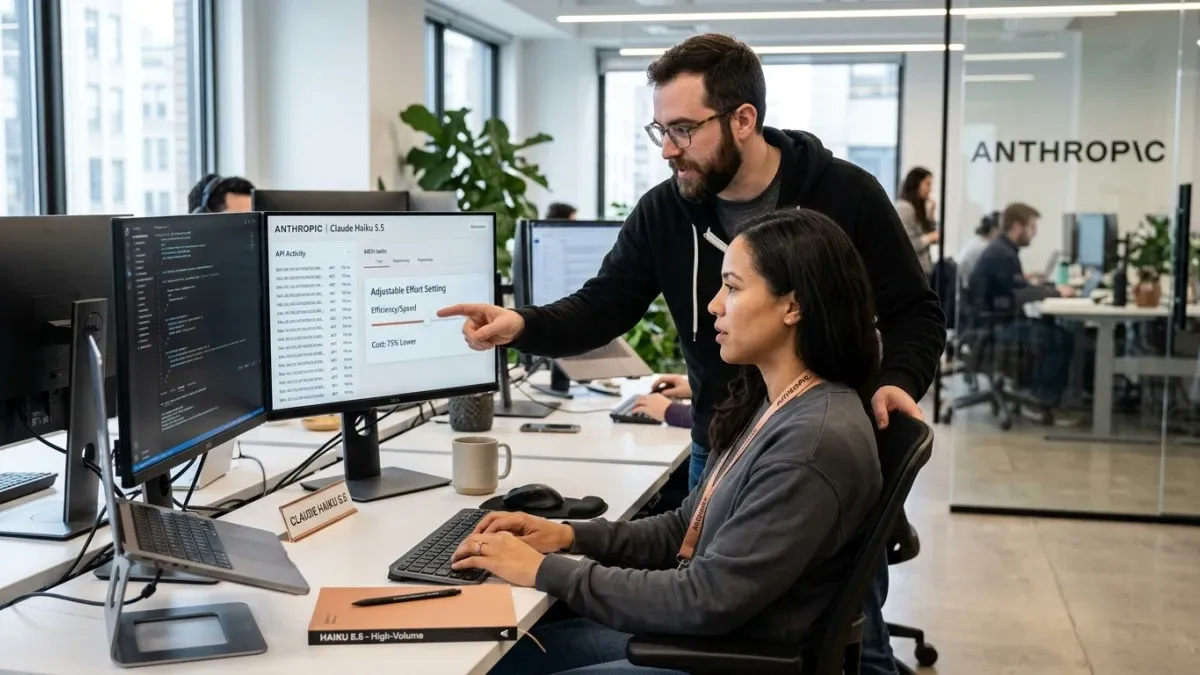
Two people collaborate at a desk in an Anthropic office, reviewing Claude Haiku 5.5 performance metrics on dual monitors.

Anthropic just made Claude 75% cheaper

Anthropic has released Claude Haiku 5.5, designed for high-volume, cost-sensitive tasks like summaries, data compaction, database queries, and classification requests. The model also serves as a subagent for coding work alongside Opus 5.5 and Sonnet 5.5, and excels at speed-sensitive applications including live customer support and browser automation. Haiku 5.5 costs approximately 75% less to run than Haiku 4.5 on average. The launch includes broader pricing improvements: Anthropic is halving the price of Claude Sonnet 5.5's cache reads—reducing Sonnet 5.5's cost on most agentic work by...

Continue reading

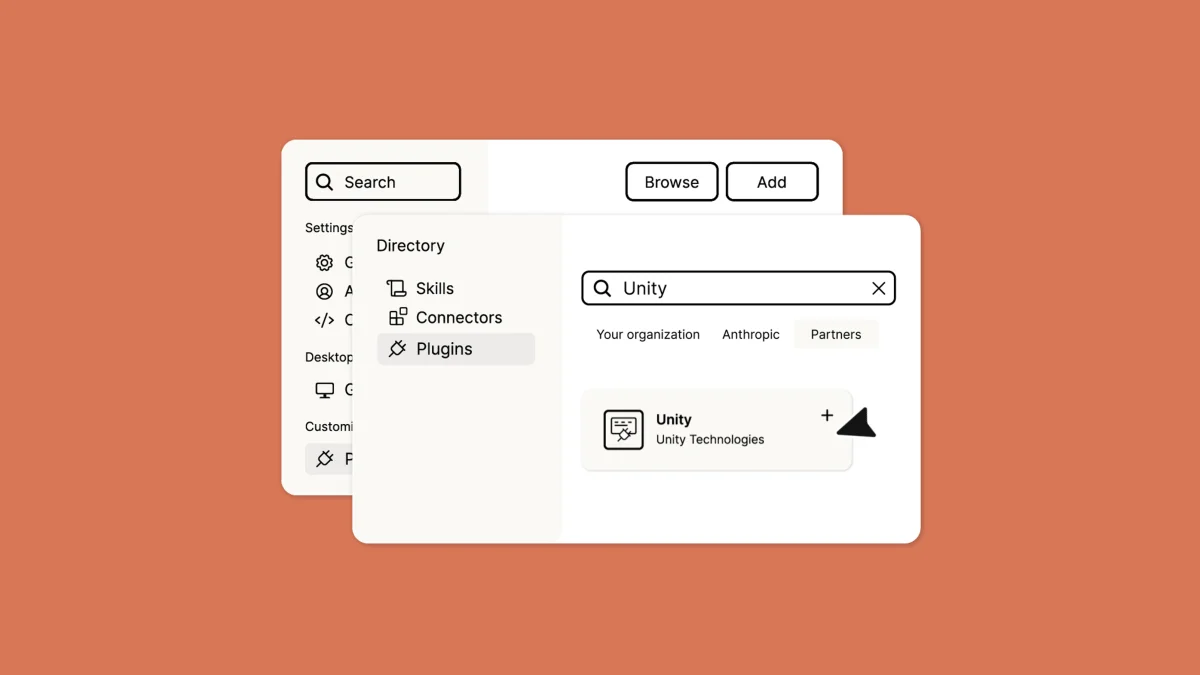
A user interface showing a plugin search for "Unity" with the Unity Technologies plugin listed under Partners.

Official Unity Plugin for Claude Code

The way developers arrive at the Unity Engine has changed faster this year than expected, with a growing number now describing a game they want to create to a coding agent rather than downloading the engine manually. When you ask an agent to help build a game today, it picks an engine for you—typically something it can install, run, and share within the same session. At Unite Seoul, Unity launched the Unity CLI so developers could point their preferred coding agent at the Unity Engine. Today, Unity is continuing that evolution with the official Unity Plugin for Claude Code, a first-party...

Continue reading

Black Unity and Grok logos side by side on a white background, separated by a vertical line.

Meeting You Where You Work: Unity Plugin for Grok Build

Over the last few weeks, Unity announced the launch of the Unity CLI followed by the official Unity Plugin, supporting the idea that Unity should meet developers in the tools they've already chosen and in the places where they work. With 3 billion Unity-powered games downloaded monthly, the CLI and plugins now sit inside the agents where a growing number of developers start projects. Game development is increasingly beginning in a terminal with an agent already open rather than in a browser on a download page. Unity's goal is to make the creation experience better and easier. The company...

Continue reading

  • 1
  • 2