smartARM's AI-Powered Bionic Arm Enables Intuitive Prosthetic Control
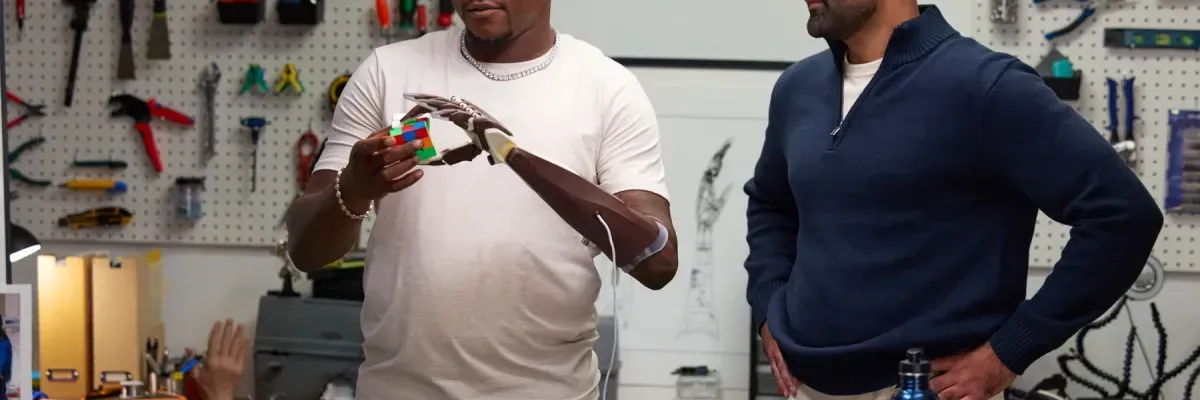
Toronto-based smartARM is revolutionizing prosthetic control by combining AI vision with intuitive design. Their bionic arm prototype learns to recognize everyday objects and automatically selects appropriate grips—eliminating the need for manual switching between grip patterns that traditionally made simple tasks unnecessarily complex.
smartARM's AI-Powered Bionic Arm Enables Intuitive Prosthetic Control
People and companies are using AI hardware and software to improve accessibility. smartARM, a Toronto-based startup, is developing a vision-first bionic arm prototype that uses open-source software and Meta AI glasses to create more intuitive prosthetic control for people with limb differences.
Traditional prosthetic hands require users to manually switch between grip patterns for different objects, turning everyday tasks like picking up a glass and then a spoon into a multistep process. smartARM addresses this by developing AI hardware and software that understands the environment and automatically selects a suitable grip—allowing users to move intuitively between tasks.
The prosthetic arm “sees” through a camera embedded in its palm. The team uses DINOv2, Meta's open-source vision model, to recognize everyday objects from just a few reference photos. This allows the arm to grip and pick up objects based on direct visual feature reading, without needing prior understanding or additional programming. The arm can adapt almost instantly to objects trained on just a few photos—a process that previously took weeks.
smartARM integrates Meta AI Glasses and the Meta Wearables Device Access Toolkit to extend object recognition, providing data from the egocentric perspective the glasses offer. The glasses give the arm additional context to better understand what the user is trying to interact with and let users add new objects through a device app on their phones, allowing the smartARM community to personalize their prosthetics around their everyday needs.
For users, the results are significant: a bionic arm that works from the first try, with no training required.
Of all the tech packed into it, scalability and accessibility matter most to me. This is the future of consumer prosthetics.
Building a capable hand is only part of the challenge. Making it intuitive to use matters just as much. By helping the arm recognize everyday objects and select a suitable grip, we're working toward an experience where people can focus more on what they want to do and less on how to operate their prosthetic.