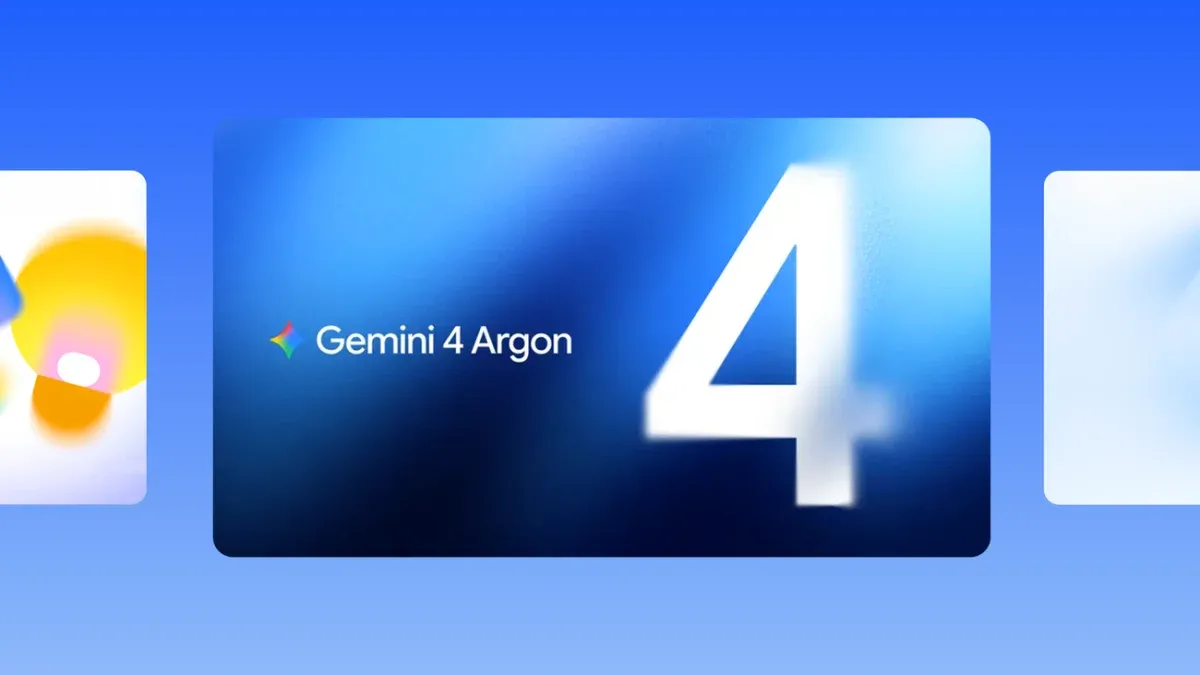
A blue gradient card displays “Gemini 4 Argon” with a large white number 4 and Google’s multicolored logo.
For more than 20 years, Google has invested in machine learning and AI research, tools, and infrastructure to build products that improve everyday life. Teams across the company are working on ways to unlock AI's benefits in fields ranging from healthcare and crisis response to education. Here's a look at some of the company's AI announcements from September.
September's headline belongs to Gemini 4 Argon, Google's newest frontier model. Built with advanced reasoning and a 1-million-token context window, it's designed to tackle complex challenges—especially in cybersecurity defense. The release capped an active month for Google AI launches that included Gemini 3.8 Flash and 3.8 Flash Cyber, expressive voice models with Gemini 3.8 Live, a Googlebook laptop pre-order, and the Gemini app on Windows. Beyond daily tools, Google marked major scientific milestones by mapping human DNA in AlphaGenome Atlas, tracking global methane from space, and launching Project Suncatcher to test machine learning hardware in orbit. Google's work on designing better AI interfaces was also recognized by Fast Company as part of the 2026 Design Company of the Year award.

Gemini 4 Argon is engineered to bring advanced reasoning to difficult problems. Built with an industry-leading 1-million-token context window, Argon excels at heavy-duty workloads like coding, cybersecurity defense, financial research, legal drafting, and autonomous cybersecurity patching. The model is currently rolling out to trusted cyber defenders through the Fairwind Program. Google is actively gathering feedback from early testers to iterate on guardrails before expanding availability to developers, enterprises, and consumers.
| Specification | Details |
|---|---|
| Context window | 1-million-token |
| Availability | Rolling out to trusted cyber defenders through the Fairwind Program |
Gemini 3.8 delivers improved reasoning and coding performance at the same speed and low cost as 3.7 Flash. Gemini 3.8 Flash provides substantial gains in long-horizon software engineering, multi-step problem solving, and agentic workflows. Gemini 3.8 Flash Cyber equips defenders with frontier-grade autonomous vulnerability discovery and automated code patching, available to trusted organizations through the Fairwind Program.

Google launched two fast, natural language audio models: Gemini 3.8 Live for everyday conversation, and Gemini 3.8 Live Extended Thinking, designed for multi-step reasoning without latency. Both rolled out for developers in Google AI Studio and Gemini API, and for everyone across Search Live, Gemini Live, and Google Workspace, enabling voice features in Gmail, Docs, and Keep.
Google also released Gemini 3.8 Flash-Lite TTS and Gemini 3.8 Flash TTS, its most expressive text-to-speech models yet. Instead of choosing from fixed presets, users get a dynamic creative studio to build voice-first applications, rolling out across products including Gemini Notebook and Google Vids.

Google brought more apps directly into Gemini, including productivity tools like Airtable, Linear, monday.com, and PandaDoc; creative platforms including Adobe, Picsart, Squarespace, and Webflow; and lifestyle services such as Peloton, SeatGeek, and Experian. Users can now tackle tasks all in one place instead of switching between tabs.

Google released Lyria 3.5 in Gemini, its most expressive music generation model yet. From text prompts or images, users can produce richer arrangements, coherent songs, and personalized audio right in the Gemini app. Lyria 3.5 is available globally in Gemini and across Google AI Studio, Google Flow Music, and Google Vids.
Gemini Notebook now includes interactive coursework tools and animated video summaries. Users can master complex topics using custom flashcards, versatile quiz formats, and 60-second Short Video Overviews in over 80 languages. Eligible college students can claim a free 12-month Google AI student plan with higher usage limits for back-to-school season.
Google Labs is expanding CC from a personal agent into a collaborative group agent designed to handle household logistics and shared schedules. CC gets its own email address to coordinate family calendars, track group to-dos, and streamline daily logistics with built-in privacy controls. CC for groups is rolling out as an experimental preview in Google Labs.
AI is transforming theoretical science into practical, everyday impact by accelerating life-saving therapies, forecasting natural disasters, and personalizing education. Google tools support more than 300 languages spoken by 7 billion people—reaching 86% of the global population. By open-sourcing models like MedGemma and partnering with leading research institutions, Google is helping scientists make discoveries faster to improve lives everywhere. New visualizations of its AI & Economy ATLAS data make it easier to see how AI is reshaping global work, including scientific research.
Project Suncatcher will launch its first test satellite with Planet to evaluate how Google TPUs perform under real space conditions. Satellites in low-Earth orbit can access up to eight times more solar power than on Earth, opening new possibilities for long-term AI infrastructure.
Googlebook, the laptop built on Android and paired with desktop foundations from ChromeOS, is now available for pre-order. Designed for Gemini Intelligence and engineered to work with Android phones out of the box, Googlebook includes on-device AI features like Magic Pointer—which lets users point and ask Gemini about anything on screen with a quick cursor wiggle—and Rambler smart voice dictation, which instantly structures verbal input into organized, shareable notes. No-code custom widgets and background task processing simplify daily workflow.
| Specification | Details |
|---|---|
| Platform | Built on Android and paired with desktop foundations from ChromeOS |
| Availability | Available for pre-order |

WeatherNext 3, Google's most advanced and accurate global weather AI model, now includes real-time satellite data, hourly refreshes, higher resolution, precise precipitation forecasting, and clean energy variables. It's integrated across Search, Gemini, Maps, Google Maps Platform, and Cloud.
Google introduced AlphaGenome Atlas, a database that predicts the effects of every possible single nucleotide variant in the human genome—all 9 billion of them. Designed to require zero coding skills, it's already accelerating real-world breakthroughs in rare disease research and complex genetics.
Google partnered with NASA's Jet Propulsion Laboratory to develop MAPL-EMIT, a deep learning AI model that tracks global methane leaks from space. The model detects 50% more emissions than human experts and has already uncovered over 23,000 previously unmapped plumes, including 24 of the world's largest.