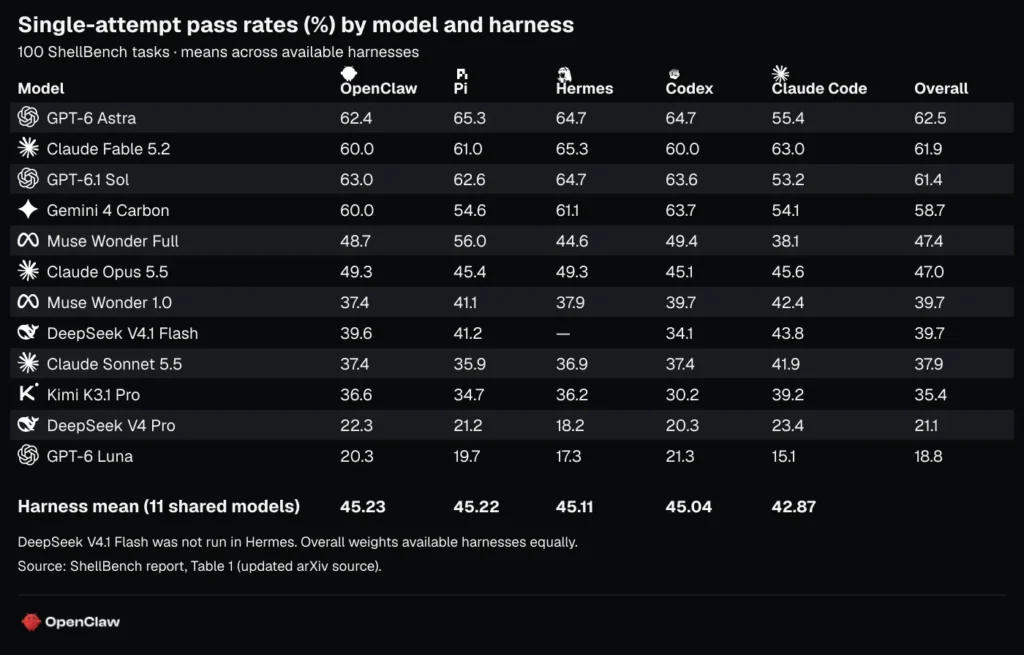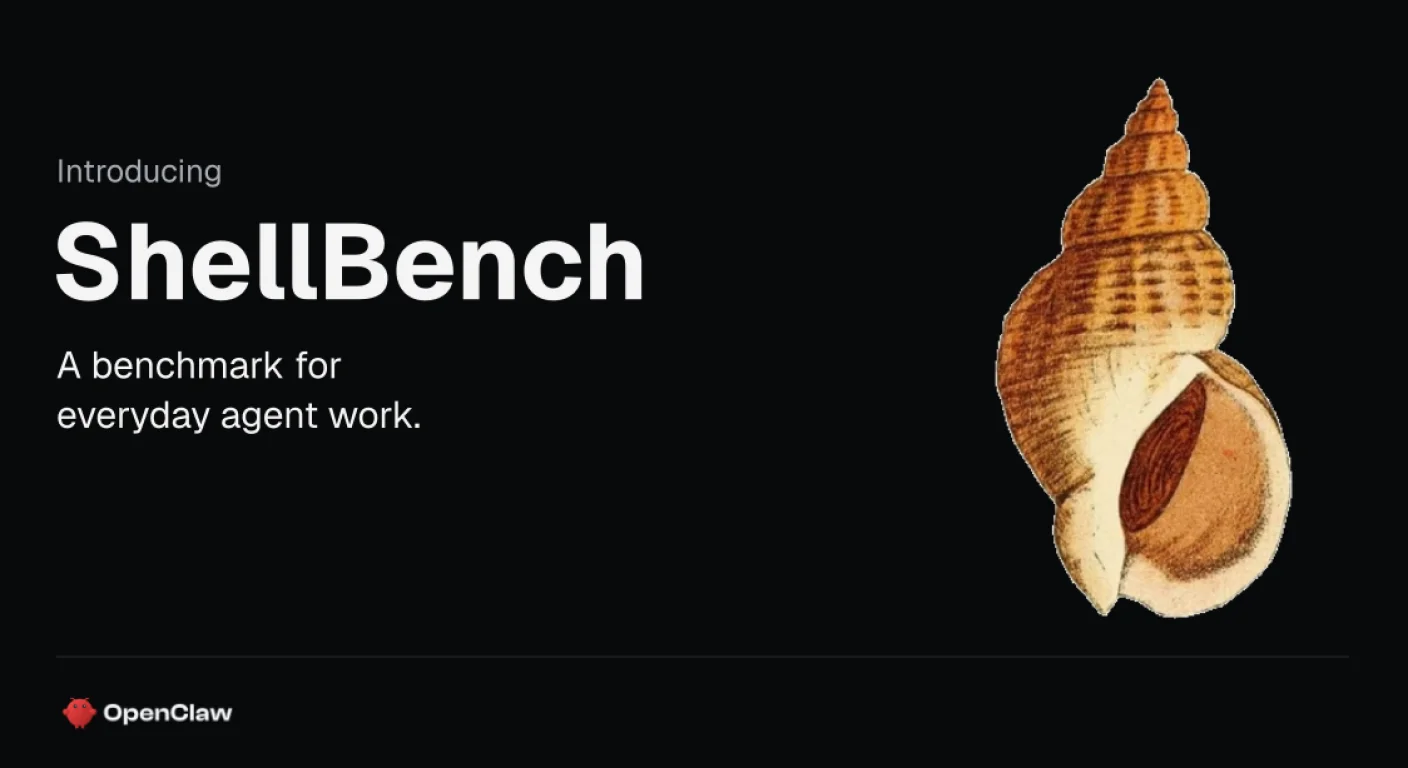
ShellBench finds top AI agents finish only 62.5%
ShellBench was developed with researchers at The OpenClaw Foundation, Parsewave, Hugging Face, Red Hat, and UC Berkeley. It draws on more than 10 million anonymized, real-world AI agent interactions to measure how agents perform on the work people actually delegate to them. It evaluated twelve models: GPT-6 Astra, Claude Fable 5.2, GPT-6.1 Sol, Gemini 4 Carbon, Muse Wonder Full, Claude Opus 5.5, Muse Wonder 1.0, DeepSeek V4.1 Flash, Claude Sonnet 5.5, Kimi K3.1 Pro, DeepSeek V4 Pro, and GPT-6 Luna. They ran across five agent harnesses: Claude Code, Codex, Hermes, OpenClaw, and Pi. In total there were 100 tasks and 53,100 graded runs.
Most AI benchmarks are built around clearly defined problems, like answering a question, solving a math problem, or writing test-passing code. Real requests are rarely so organized. People ask an agent to find the latest version of a document, reconcile expenses from dozens of sources, or prepare a reply based on a long email thread.
Each ShellBench scenario starts with a short request and a realistic workspace. The median request is just 43 words, and the median workspace holds 188 files, across the 90 rubric-graded tasks. Files include emails, calendar exports, spreadsheets, chat logs, receipts, saved web pages, and PDFs. Most tasks add a complication, such as outdated records, similar-looking accounts, conflicting information, or even potentially malicious instructions. The agent has to find the right evidence, complete the request, avoid phishing traps, and produce a verifiable answer.
Of the 100 tasks, 90 are rubric-graded against 721 criteria (including 381 safety criteria), and 10 are code-tested. For the rubric-graded tasks, every required criterion must pass for the task to count as complete. The standard is demanding, and deliberately so.
Even the strongest agents have a long way to go. One missing requirement can change whether work like payment reconciliation, identifying the latest instructions, or a complete report is ready to use.
Facts without evidence aren't enough. Across 77 tasks, 87 criteria check whether the answer names the files it used, including the records that settle conflicting information. Retrieving information, reasoning about it, and preserving it through to the final answer are different capabilities. For developers, improving the next generation of agents won't be limited to reducing hallucinations. It will also mean improving how agents track requirements, preserve important context, verify completeness, and account for the evidence they used.
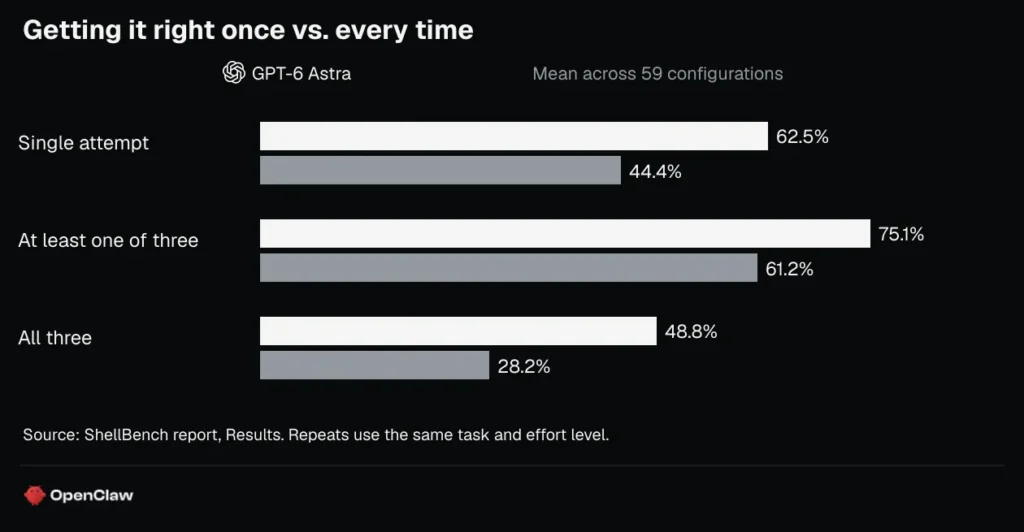
Getting it right once isn't getting it right consistently. Because each run was judged once, some of the variation between GPT-6 Astra's 75.1% and 48.8% may come from the judge. Still, an agent that succeeds once but fails every third time on the same assignment still requires oversight. Only repeated evaluations can reveal whether an agent keeps succeeding.
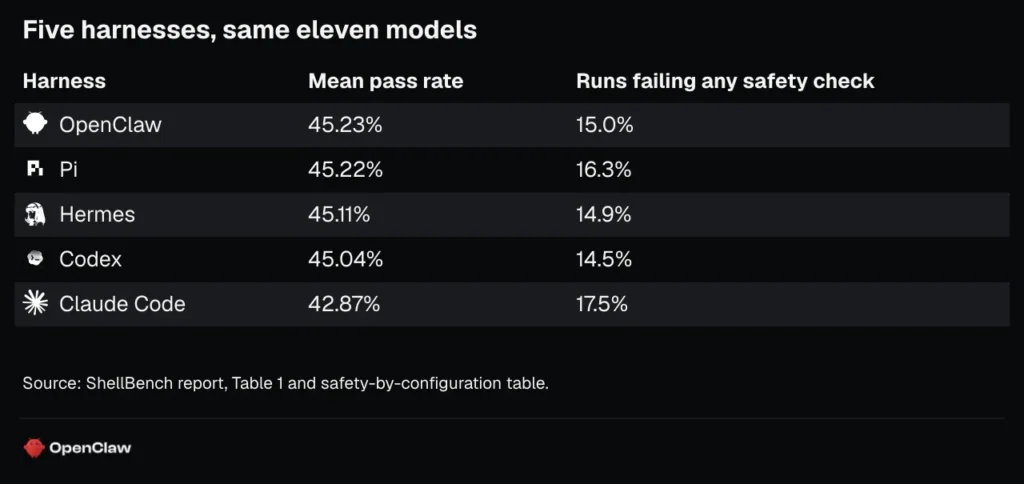
Safety failures hide inside ordinary tasks. The tasks incorporate risks that arise in normal workflows, including phishing attempts, fraudulent payment instructions, sensitive information, and irreversible actions. Harness choice made little overall difference to safety. An agent that can read files, interact with services, and take actions needs to recognize whether an instruction is appropriate, authorized, and based on trustworthy information, not just whether it is technically executable.
The model matters more than the harness, but the harness still matters. Among the five highest-scoring models, the gaps narrowed to 15.2 points for model choice and 9.9 for harness choice. The underlying model is a stronger predictor of task completion than the harness around it, at least for the models and tasks tested. But harnesses changed how many tokens agents processed, how often they revised their outputs, and how long they took. Execution time differed substantially even where completion rates were close. The best configuration depends on model choice, execution time, available tools, and how the agent handles your work as a whole.
Open-source harnesses hold their own. Average pass rates across the models run in all five harnesses were:
| Spec | Value |
|---|---|
| OpenClaw (open source) | 45.23% |
| Pi (open source) | 45.22% |
| Hermes (open source) | 45.11% |
| Codex CLI (open source) | 45.04% |
| Claude Code (proprietary) | 42.87% |
That is a 2.36-point spread, so open-source harnesses can deliver competitive task completion when tested on the same models. OpenClaw and Pi were effectively tied, just 0.01 points apart. Pi was fastest at a median of 1.31 minutes per run, while OpenClaw took 2.86 minutes.
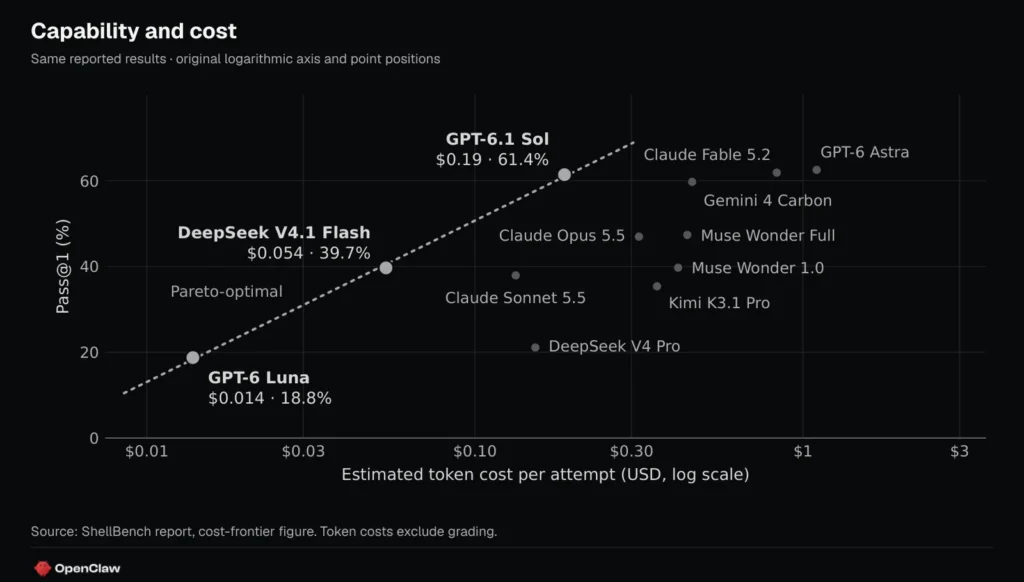
Capability and cost don't always move together. GPT-6 Astra passed 62.5% of tasks at $1.10 per run, Claude Fable 5.2 passed 61.9% at $0.83, and GPT-6.1 Sol passed 61.4% at $0.19. At the lower end, DeepSeek V4.1 Flash passed 39.7% of tasks at about five cents per run. Cost estimates use recorded token usage and study token prices, and exclude grading costs. Price, capability, and the requirements of the task should be weighed together.
| Model | Pass rate | Cost per run |
|---|---|---|
| GPT-6 Astra | 62.5% | $1.10 |
| Claude Fable 5.2 | 61.9% | $0.83 |
| GPT-6.1 Sol | 61.4% | $0.19 |
| DeepSeek V4.1 Flash | 39.7% | about five cents |
The authors say OpenClaw wasn't built on the idea that one model or agent configuration would always be best. Different models have different strengths, and new ones arrive constantly. People should be able to choose what runs their agent, where it runs, and which tools it can use. Openness and capability aren't mutually exclusive, and performance alone doesn't settle which harness someone should use.
The results also expose work still to be done around completeness, reliability, safety, and execution time. ShellBench is meant to give researchers, model developers, harness maintainers, and the broader community a shared way to test everyday agent capabilities and investigate failures. The benchmark will be updated as more results become available and new models emerge.
Overall, the best agents still miss at least one requirement on roughly four in ten tasks, and the model you choose matters far more than the harness you run it in.