Anthropic Introduces Claude Fable 5.1 and Claude Mythos 5.1
Anthropic has unveiled Claude Fable 5.1 and Claude Mythos 5.1, two advanced AI models designed to excel at coding, knowledge work, and scientific discovery. With improved safeguards, reduced pricing, and enterprise-grade privacy options, these models represent a significant leap forward—but the stakes of their capabilities demand rigorous scrutiny.
White text reading “Claude Fable 5.1 and Mythos 5.1” overlaid on a blue sky with soft clouds and a crescent moon.
Anthropic is introducing Claude Fable 5.1 and Claude Mythos 5.1, positioning them as the world's most advanced models for coding and knowledge work, with research capabilities that offer an early glimpse of how AI models will contribute to scientific progress.
Fable 5.1 and Mythos 5.1 are the same underlying model with different levels of safeguards. Fable 5.1 is generally available, while Mythos 5.1 is available only through Anthropic's trusted access programs, with safeguards specifically designed to support work in cybersecurity and the life sciences.
Alongside increased capabilities, Fable 5.1 addresses customer feedback on price, data retention, and safeguards.
Pricing. Fable 5.1 costs an estimated 25% less than Fable 5 for typical workloads billed by token, due to reduced pricing on cache reads. For highly agentic work, savings reach approximately 45%.
Data retention. Anthropic's new Enterprise Frontier Safeguards (EFS) system gives customers complete privacy while preventing adversarial use by storing data in cloud infrastructure controlled entirely by the customer rather than Anthropic. EFS will be made available to enterprise customers in phases beginning this fall. Until then, eligible customers can use Fable 5.1 with zero data retention.
Safeguards. Improved safeguards reduce false positives by 60% in cybersecurity contexts. Fable 5.1 can now discover software vulnerabilities—though not develop exploits for them. In biology, Anthropic established an access program developed in partnership with the US government to enable access to Claude Mythos 5.1's advanced biology capabilities, with enrollment for scientists opening soon.
A new performance frontier
Claude Fable 5.1 sets a new standard for coding, knowledge work, and long-running problem-solving tasks. When set to Low or Medium effort, Fable 5.1 achieves results similar to or better than Fable 5 at substantially lower cost. (Fable 5.1 defaults to High effort in Claude Code and Medium in Claude Cowork and on Claude.ai.)
Fable 5.1 avoids shortcuts that result in poorer-quality work and is capable of fixing root causes of software issues. In testing by the investment firm Millennium, Fable 5.1 found the cause of a rare crash in its internal systems that none of its engineers or any other model had been able to explain after several years of trying.
Fable 5.1's performance across benchmarks:
Benchmark
Fable 5.1
Fable 5
Opus 5
GPT-5.6 Sol
Agentic scientific research (Terminal-Bench-Science 0.1)
52.6%
24.7%
29.0%
22.4%
Agentic coding (Terminal-Bench 4.0)
55.8% / 60.9% (Mythos 5.1)
42.0%
52.3%
37.3%
Knowledge work (GDPval-AA v2)
1853
1723
1824
1711
Computer use—partial (OSWorld 2.0)
77.9%
72.9%
75.4%
—
Computer use—strict (OSWorld 2.0)
41.7%
36.1%
39.6%
—
Multidisciplinary reasoning—no tools (Humanity's Last Exam)
60.9%
57.8%
56.6%
—
Multidisciplinary reasoning—with tools (Humanity's Last Exam)
65.0%
63.8%
63.6%
—
Business workflows (AutomationBench)
31.4%
17.1%
26.9%
19.6%
Agentic coding (CursorBench 3.2.0)
73.4%
70.5%
70.0%
67.2%
Fable 5.1 was evaluated with production safeguards enabled. On tasks where safeguards intervened, Fable 5.1 and Fable 5 scored zero on OSWorld 2.0, and Fable 5 scored zero on AutomationBench. In other safeguard interventions, cybersecurity tasks were completed by Claude Opus 4.8 and biology tasks by Claude Opus 5, likely reducing Fable 5.1 and Fable 5 performance on these benchmarks.
Scientific research
Testing revealed that Claude Fable 5.1 and Claude Mythos 5.1 demonstrate capabilities that add to evidence that AI models will soon make important contributions to scientific discovery.
Molecular design. Claude Mythos 5.1, given access to open-source protein design and folding tools, proved able to design very high-affinity binders for molecular targets. On three targets, its binding affinities were 10 times higher than the best designs submitted to Adaptyv Bio's protein design competitions. Its hit rate—the number of designs that were viable binders—reached nearly 50% across 12 targets, compared to typical hit rates of 10–15% in protein design.
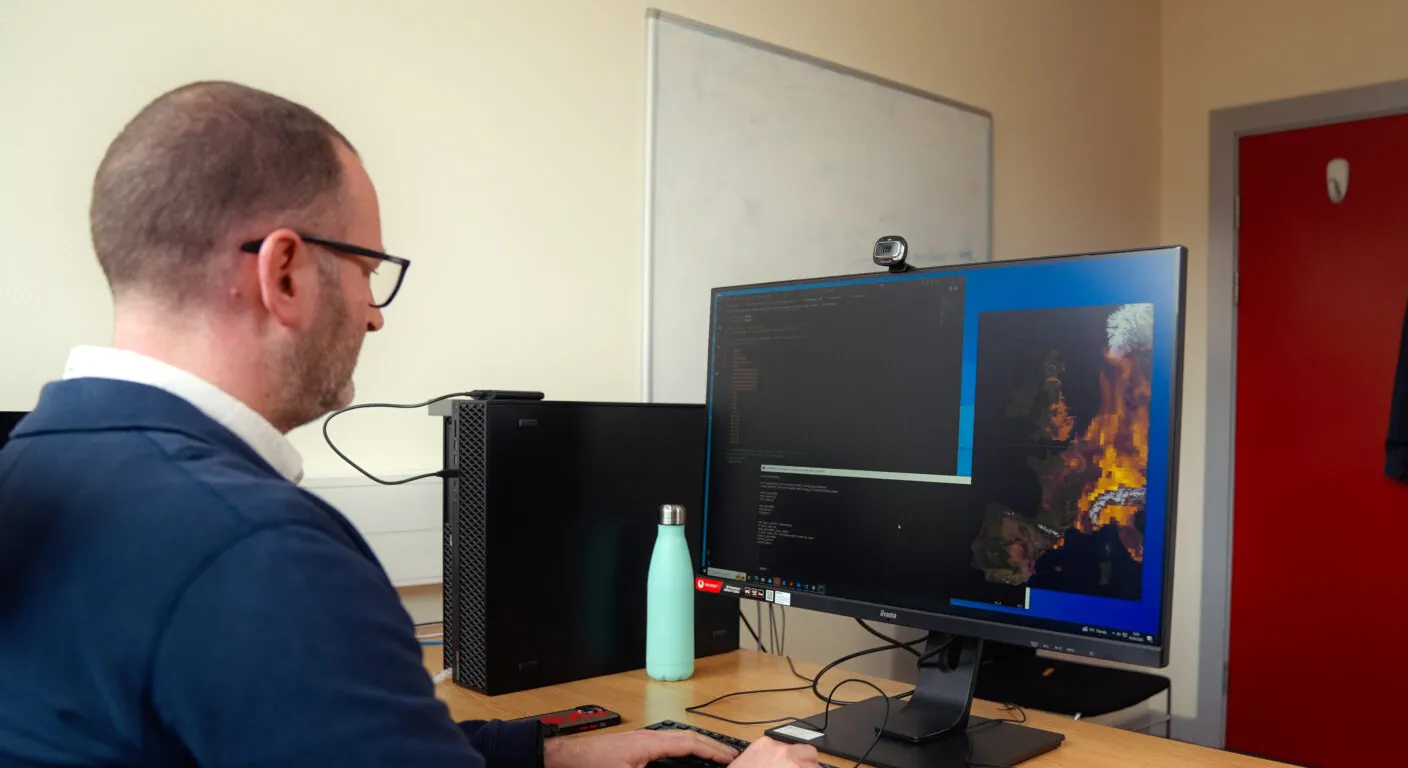
Computational analysis and modeling. Claude Fable 5.1 trained a neural network to create a high-resolution elevation map of a third of Venus based on radar images from NASA's Magellan mission taken more than 30 years ago and an existing map covering one-fifth of the planet. The new map reveals details down to two to three kilometers rather than 10 to 20, and shows heights up to 25% more accurately. Anthropic is releasing this map under a Creative Commons license ahead of upcoming NASA VERITAS and ESA EnVision missions to help determine which geologic features to target for future observation.
Computational biology. In computational biology, Mythos 5.1 addressed a common bottleneck by writing custom GPU kernels and caching intermediate results, speeding up seven open-source deep learning models by up to 2.5 times with identical outputs. For genome-wide analyses where biologists run models thousands of times, the optimized models cut estimated GPU costs by 30–60%. This optimization would normally require weeks of work from a team of performance engineers and is often unaffordable for academic labs. Mythos 5.1 completed it in days using publicly available source code alone. Anthropic plans to open-source these optimizations.
As scientific capabilities improve, Anthropic is expanding its investment in scientific progress. Recently, the company previewed the Model Hardware Standard, which allows Claude to directly and safely operate laboratory equipment, and expanded support for scientists through its AI for Science program, which provides free credits for high-impact research projects. Anthropic is also offering steeply discounted usage through a new Claude Team plan for scientists.
Safety, security, and alignment
AI models' agentic capabilities have become significantly more powerful over the past two years. Greater autonomy comes with new risks, and work on safety, security, and alignment must advance at the same pace as capabilities. Prior to releasing Claude Fable 5.1 and Claude Mythos 5.1, Anthropic and external researchers subjected the models to extensive testing across many risk areas, detailed in the System Card.
Chemical and biological risks. Anthropic tested the extent to which Claude Mythos 5.1 could help create chemical or biological weapons through expert red-teaming, automated evaluations, and a tabletop exercise pairing PhD-level biologists with AI experts. Mythos 5.1's capabilities exceed those of Mythos 5, but evaluations indicate it still falls short of the next risk tier defined in Anthropic's Responsible Scaling Policy. Mythos 5.1 is therefore deployed with the same safeguards as Mythos 5.
Model
Price
Where to buy
As-of date
Claude Fable 5.1
$10/M input; $50/Moutput
Claude API; Amazon Bedrock; Google Cloud; Microsoft Foundry
Sep. 2026
Claude Mythos 5.1
$10/M input; $50/M output
Invitation-only Project Glasswing; AWS, or Google Cloud