Understanding YOLO Mode: How to Give AI Agents Freedom Safely
AI agents have grown significantly in capability and adoption since generative AI went mainstream in late 2022. In Stack Overflow's 2025 Developer Survey, 84% of developers said they use or plan to use AI tools in their workflow, up from 76% a year earlier. As these tools shift from suggesting code to writing files and running commands autonomously, a practical question emerges: How much should an agent be allowed to do without stopping to ask? Developers call the extreme end of this spectrum YOLO mode.
Understanding YOLO mode before enabling it is important, but the main risk is often misunderstood. The danger depends on where an agent runs. On your own machine, one mistaken command can delete files, expose credentials, and make unwanted network requests. Inside a proper boundary, however, developers can use agents in YOLO mode to unlock new productivity levels without jeopardizing security.
YOLO mode is the community nickname for running an AI agent with every action auto-approved. When enabled, agents can read files, write code, run shell commands, and call tools without stopping for user approval. Different platforms implement it with different names:
The names differ, but the behavior is identical: remove the prompts and let the agent proceed. YOLO mode appeared first in Cursor, then Claude Code, and by 2026 it's become a standard toggle in most coding agents.
A careful agent constantly asks for permission: “Can I edit this file, run this test, install this package?” This can mean dozens of prompts for a single feature. While these requests help prevent agents from going rogue, each approval forces a context switch that disrupts the workflow that made using an agent worthwhile.
Developers enable YOLO mode for several reasons:
Removing approvals eliminates these friction points and allows agents to deliver the promised speed. But what's the cost?
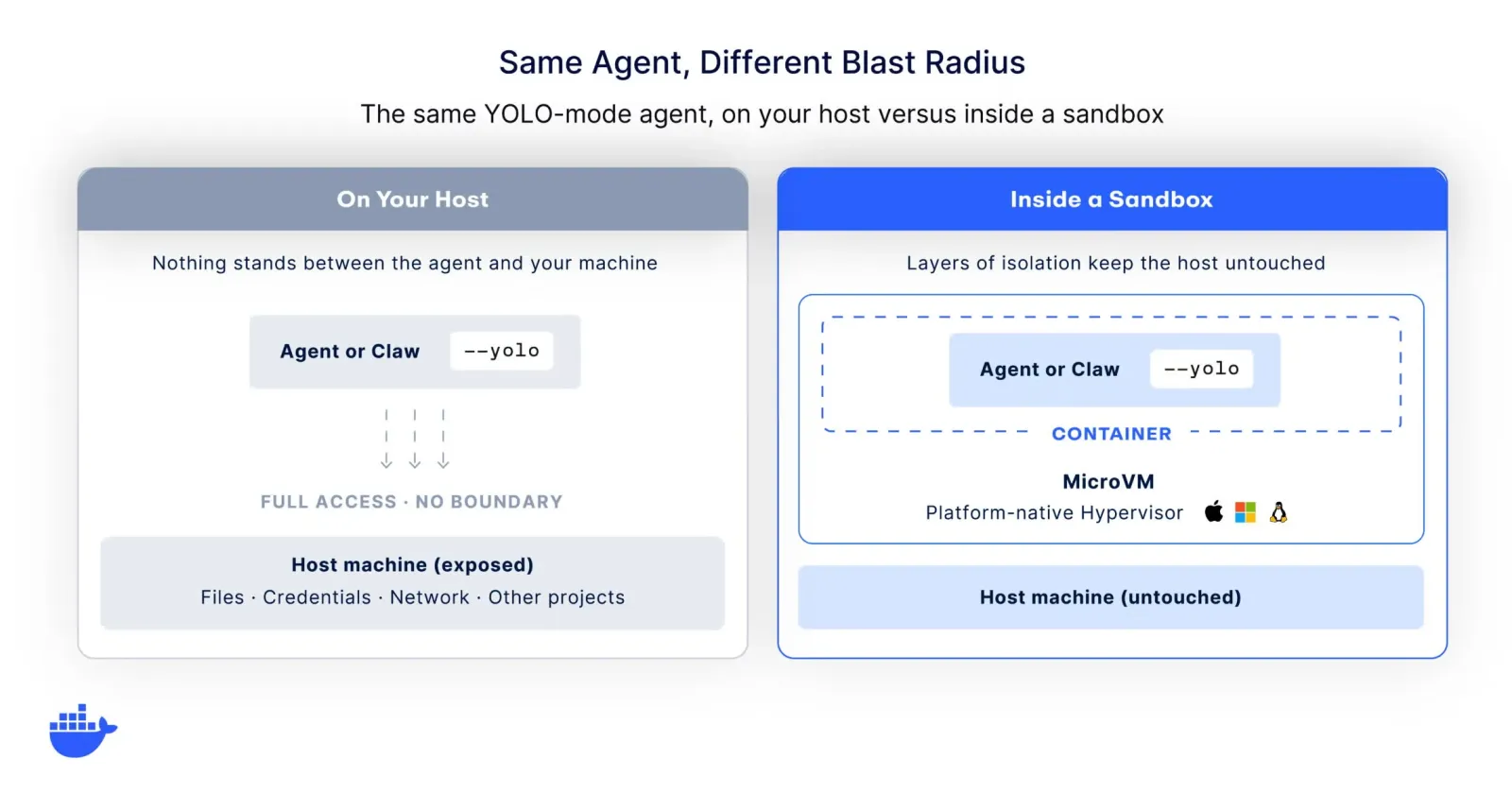
Removing prompts removes the last human check before an action runs, which amplifies the security risks agents already carry. When an agent works directly on your host machine, it has the full run of your system—your files, environment variables, credentials, and network. A confused or compromised agent can cause significant damage with nothing to stop it.
On an unprotected host, YOLO mode introduces risks such as:
Keeping manual approvals enabled doesn't eliminate all risk either. Permission fatigue can make it easy to accidentally approve the wrong request, so the real safeguard must be in the environment where an agent runs, where a bad command or tired click has greatly reduced impact.
The answer isn't better prompts but a boundary the agent cannot cross. Guardrails only work when something outside the agent enforces them. The agent needs a bounding box with constraints set before it runs and clear limits on what it can access. Inside that box, it should be free to move as fast as needed. The goal is to shape the environment so mistakes cannot damage your systems or leak secrets.
In practice, this means running the agent in an isolated, ephemeral environment instead of on your host. The agent gets a real workspace where it can install packages, run services, and edit files, but it cannot see your credentials, reach your other projects, or touch the host.
Unlike a container that shares the host kernel, a microVM puts a hardware-level boundary around the agent, so isolation holds even if the agent tries to break out, and it does so without significant performance penalties. If a run goes sideways, you destroy the environment and start fresh. This is core to sandbox security and why agents need isolation in the first place.
For one developer on a sandboxed machine, YOLO mode is a personal choice. Across a team, it becomes a policy question. A hundred developers each deciding when to skip permissions creates the ungoverned-autonomy problem that keeps security leaders up at night. The approach that works at scale is making the safe path the default: every agent runs inside an isolated, disposable environment, configured once at the organization level for everyone.
This is the problem AI Governance solves. You define rules once across surfaces that matter—network access, the filesystem, and the tools an agent can reach—then enforce them automatically at every developer's machine. Governance turns a per-developer judgment call into a consistent, repeatable capability. Clear boundaries let an organization extend autonomy to its agents while keeping risk contained. Once the boundary is standard, YOLO mode becomes fast and safe for everyone.
Once the boundary is in place, developers can stop supervising every step:
That's the real appeal, and the sandbox makes it safe to rely on.
YOLO mode really poses a question: How much autonomy can you give an agent before risk outweighs speed? The answer stops being about the agent and starts being about its environment. Give an agent the run of your laptop and even small mistakes are expensive. Give it a boundary it cannot cross and you get speed with minimal exposure.
That's what Docker Sandboxes is built for. Each agent runs in its own disposable microVM with control over networking, filesystem access, and resource limits, so you can run agents in YOLO mode safely from day one. For teams wanting those boundaries applied consistently across all developer environments, Docker AI Governance sets and enforces the rules everywhere. Define the box, then let the agent go.
It depends entirely on where the agent runs. On your host machine, YOLO mode is risky because a mistake or prompt injection can reach your files and credentials. Inside an isolated, disposable environment with scoped access and no real secrets, the blast radius is contained and YOLO mode is reasonable to use.
It turns off confirmation prompts, so Claude Code reads, writes, runs commands, and calls tools without asking at each step. It trades the safety of human review for speed and is the most common way people run Claude Code in YOLO mode.
Run the agent inside an isolated sandbox rather than on your main machine, give it scoped network access and throwaway credentials instead of your real ones, work against a cloned or disposable copy of your project, and keep a way to inspect what it did. The goal is a boundary the agent cannot cross, not more careful prompts.
Not exactly. Full YOLO mode approves everything. Some tools now offer a classifier-gated auto mode that runs safe actions automatically while still blocking or flagging dangerous ones. That's a useful middle ground, but it's a filter on top of the agent, not a boundary around it. Isolation still matters.