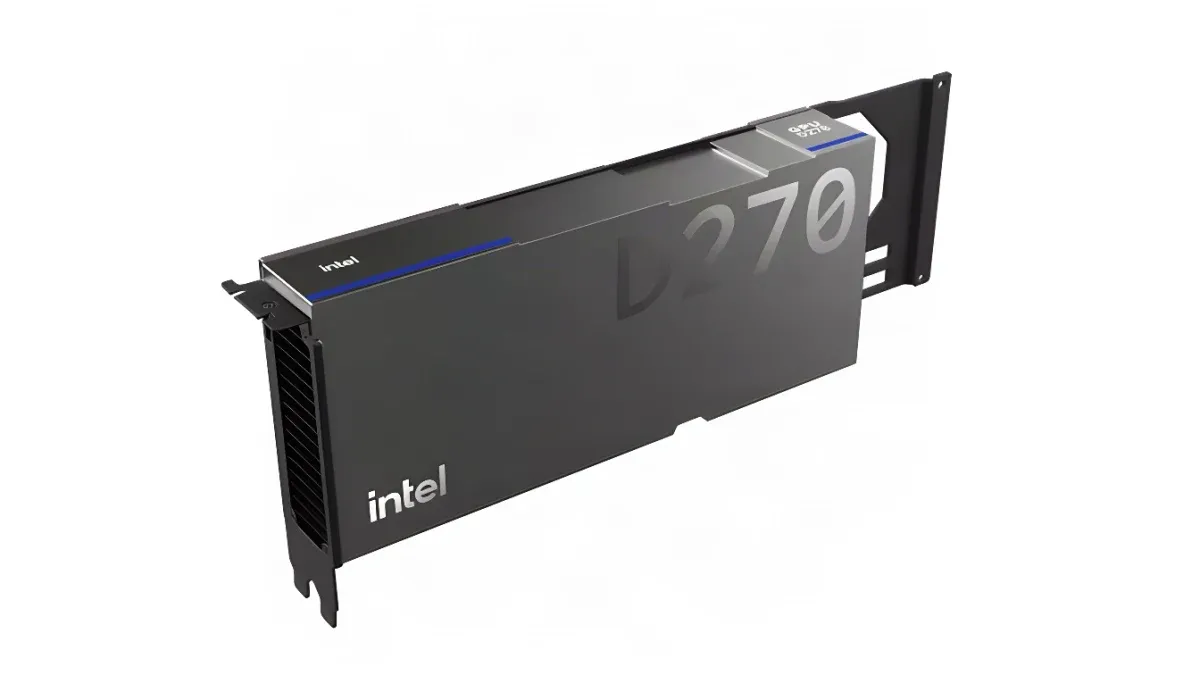
Intel's GPU D-series, code-named Crescent Island, is built for AI inference on Intel's Xe3P architecture. It combines up to 480 GB of LPDDR5X memory, 1.5 TB/s of memory bandwidth and 1.3 petaflops of FP8 compute. For teams running memory-heavy inference, that balance is the core pitch: more capacity per card without specialized infrastructure.

Key Features at a Glance

- Memory and bandwidth: Up to 480 GB of LPDDR5X at 1.5 TB/s, aimed at sustained, memory-intensive inference.
- Compute and power: 1.3 petaflops of FP8 compute within a 350-watt power envelope.
- Model capacity: Supports models with up to 300 billion parameters on a single card and more than one trillion parameters in an eight-GPU system.
- Deployment: Standard PCIe form factor and air-cooled design, so it can fit existing data centers without specialized rack or cooling infrastructure.
- Software portability: A common Xe software foundation supports application portability across Intel GPU platforms.
- Xeon racks: Select Xeon 6+ configurations scale beyond 46,000 cores per rack at 133.45 kW total rack power, many built on the Open Compute Project's Open Rack v3 (ORv3) standard.
- Day 0 model support: Intel has added Day 0 support for Meta's Muse Glimmer, helping developers evaluate emerging agentic AI workloads faster.
Target applications include multi-tenant AI services, robotics and other latency-sensitive workloads.
Availability
Customer sampling is underway, and Intel is showing the hardware at the OCP Global Summit at booth B32, including Nic Dubé's keynote “Put Every Prompt in Its Place” on October 13 at 10:30 a.m. PT.
Most Read
What the community is saying
community speaking about this topic
Nobody has commented on this yet.
💬 Be the first to comment

Felipe Santos
“Artificial intelligence can process the world in milliseconds, but only the human heart can give meaning to every second lived” – Mr. Santos