Google's Gemini 4 Neon cuts task costs 32%
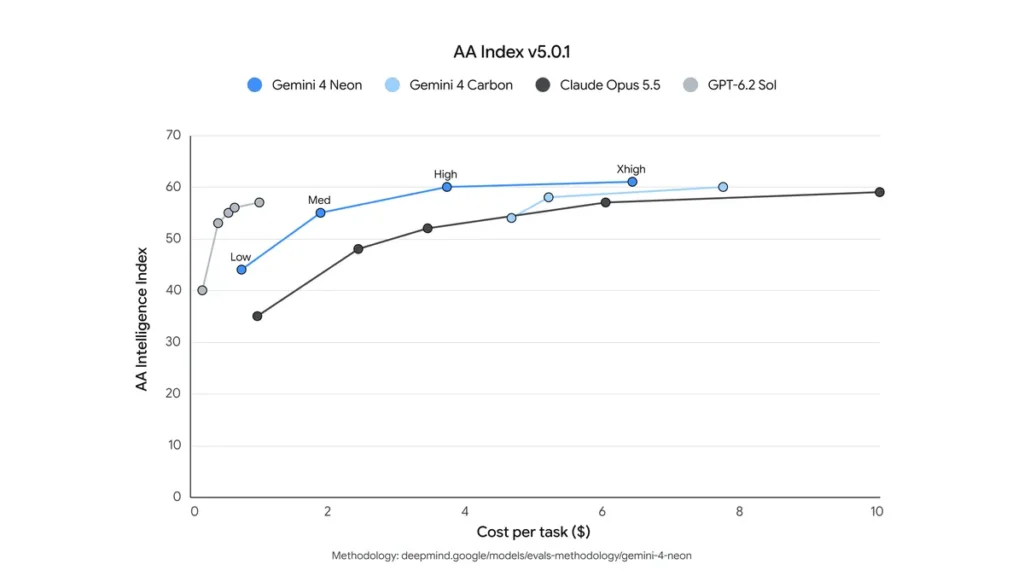
Google introduced Gemini 4 Neon, a model that brings frontier-level intelligence with fast end-to-end task completion across complex software engineering, knowledge work, and science workflows. Neon ranks ahead of comparable models and #3 overall with a score of 61 on the Artificial Analysis Intelligence Index at its xhigh thinking level, landing just behind larger, slower models. At its default high thinking level, it pairs a high Index score with a 32% lower cost per task than Gemini 4 Carbon.
On the Vals Index, Neon ranks #2 and lands on the Pareto frontier. Google says it is also continuing to make its models better to work with: Neon ranks #2 on steerability (adapting cleanly to mid-task user corrections) on the new Agent Arena Index. It also excels at multi-step instruction following and records Google's lowest fabrication rate yet in internal Google Antigravity testing.
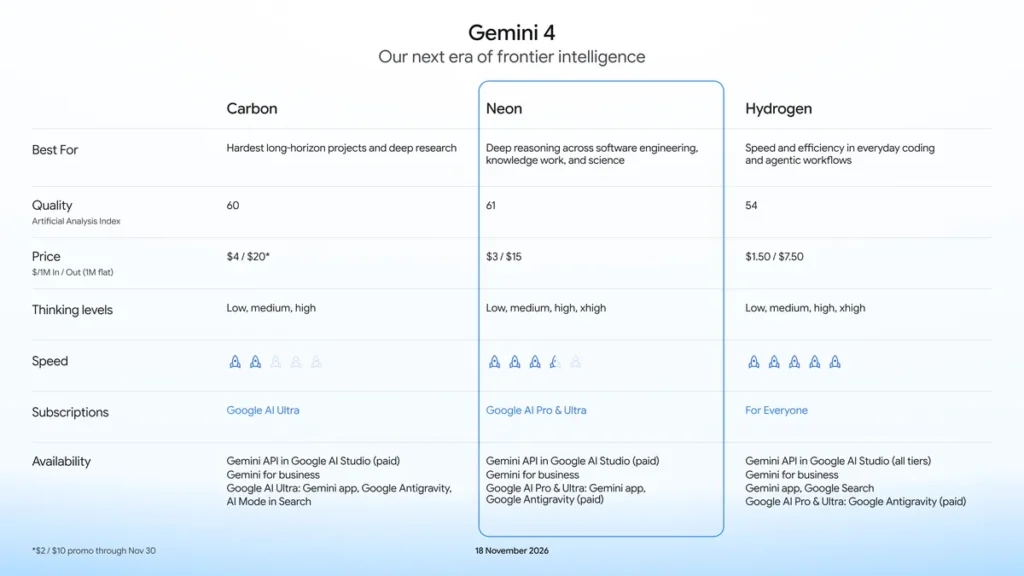
The model is priced at $3 per million input tokens ($0.15 per million cached input tokens, a 95% discount) and $15 per million output tokens, with a 1 million-token context window.
| Spec | Value |
|---|---|
| Input tokens | $3 per million |
| Cached input tokens | $0.15 per million (95% discount) |
| Output tokens | $15 per million |
| Context window | 1 million tokens |
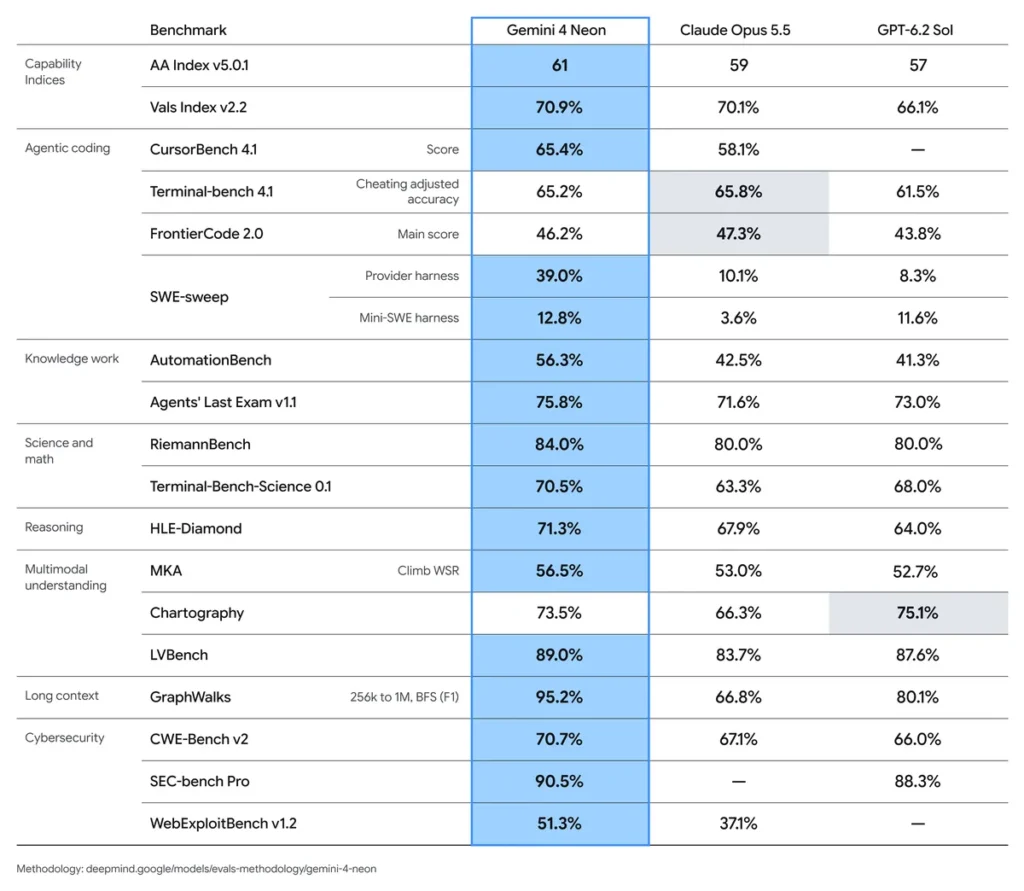
Enterprise work lives in spreadsheets, PDFs, charts, audio, and video. Neon can synthesize across all of these inputs in a single 1 million-token context window and turn them into structured deliverables. On the Vals Index it ranks #2 (70.9%), and it reaches #1 on both the Legal Research Bench and Tax Agent Bench.
On Surge AI, Neon ranks #1 on most benchmarks across finance, accounting, spreadsheet modeling, and complex constraint following. It scores 73.5% on Chartography for reading dense professional charts and performs on par with leading models on Agents' Last Exam v1.1 (75.8%). It achieves #1 overall on both Zapier's AutomationBench (56.3%) and Andon Labs' Vending-Bench 2 ($16,843), a long-horizon simulation of running a business. It debuts #2 globally with a score of 1336 on Arena's new Agent Arena Index across 4,200+ real-world agent sessions.
On scientific and mathematical reasoning, Neon is best in class on Terminal-Bench Science (70.5%), RiemannBench (84.0%), and HLE-Diamond (71.3%).
Engineered for long-running agent workflows, Neon sustains performance through complex, tool-heavy tasks end-to-end. It can run standalone or act as a fast, high-judgment Orchestrator directing parallel Hydrogen subagents in Google Antigravity. It cuts down on redundant file reads, shares progress as it works, and handles context compaction reliably in long sessions.
Neon ranks #1 overall on the Artificial Analysis Coding Agent Index (58.6). It scores 65.2% on Terminal-Bench 4.1 and 46.2% (at its default high setting) on FrontierCode 2.0. It handles multi-file debugging and refactoring across repositories with targeted, surgical edits. On SWE-sweep, it leads on the mini-SWE harness (12.8%) and more than triples to a state-of-the-art 39.0% in Google Antigravity.
Google is refining thinking levels with each release to give teams finer control and a smoother progression from one tier to the next. Neon's four levels scale steadily, letting teams dial intelligence and token spend to what each workload needs.
At high, Neon sits on the Pareto frontier on both the Vals Index and Agent Arena, with roughly 50% to 80% lower cost per task than top competing frontier models. The xhigh level adds deeper, multi-step reasoning for the hardest engineering, analytical, and scientific workloads. It shows Neon's highest intelligence score while still costing 36%+ less per task than competing models at their highest setting.
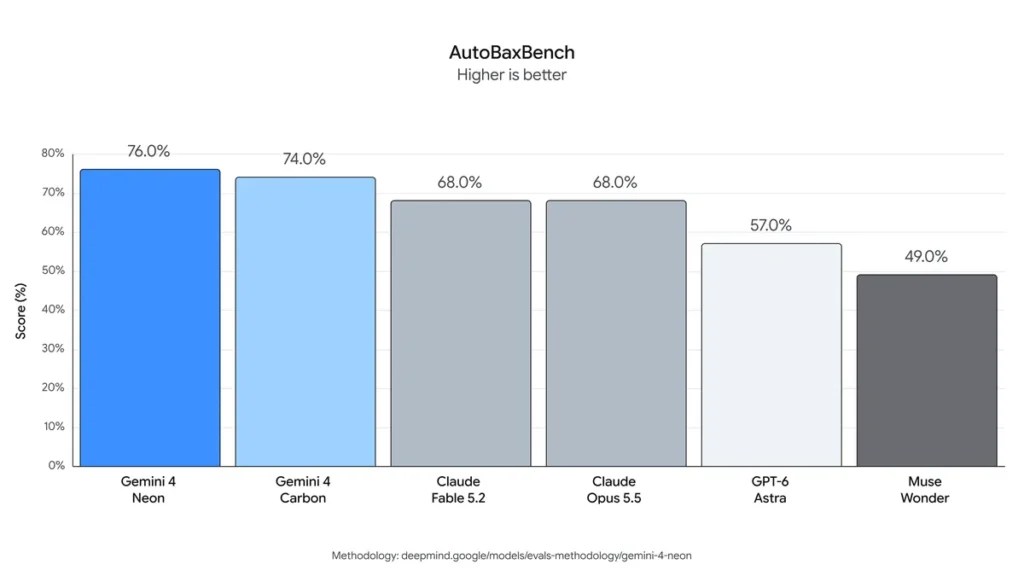
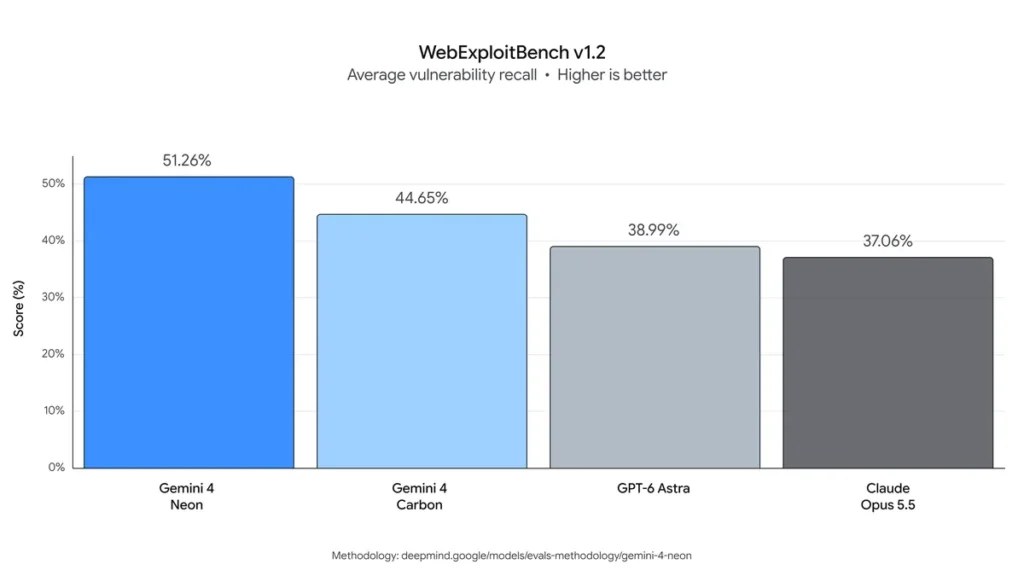
Gemini 4 Neon for cyber produces more secure code than Carbon across all easy, medium, and hard challenges on AutoBaxBench, achieving state-of-the-art on the hard tier (76%). On WebExploitBench v1.2, Neon is state-of-the-art (51.26%) at half the cost of competing large models.
Across the code hardening lifecycle, Neon is faster and more cost efficient than large frontier models:
| Spec | Value |
|---|---|
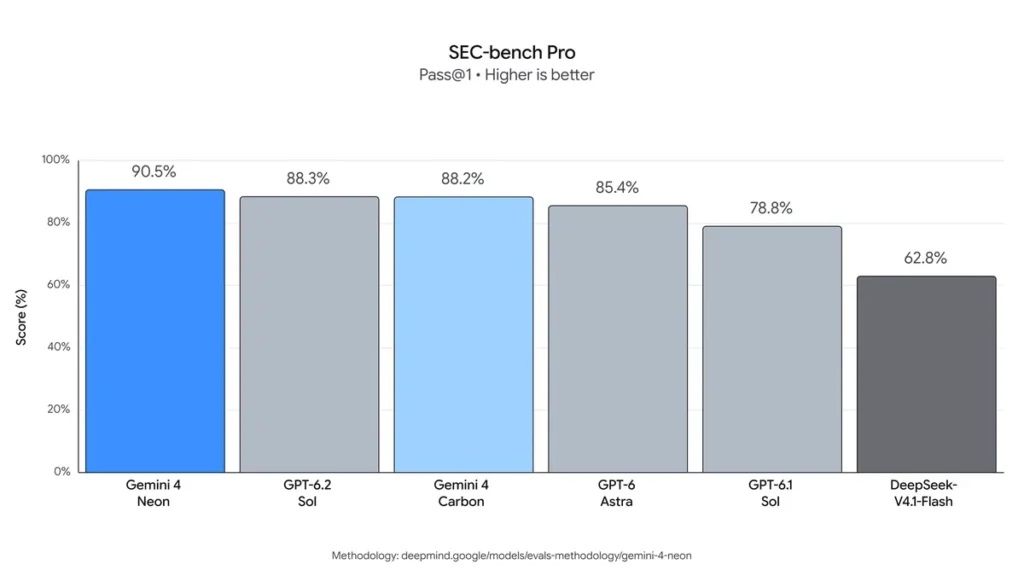
| Finding vulnerabilities | state-of-the-art on SEC-bench Pro (90.5%), at roughly half the cost per challenge. |
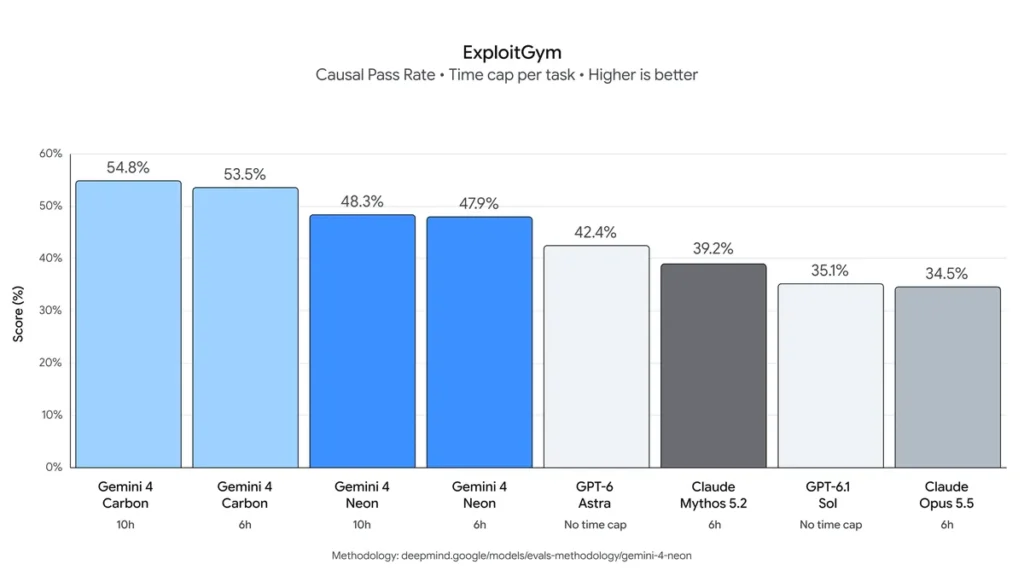
| Validating exploitability | frontier-level performance on ExploitGym using half the tokens of Carbon. |
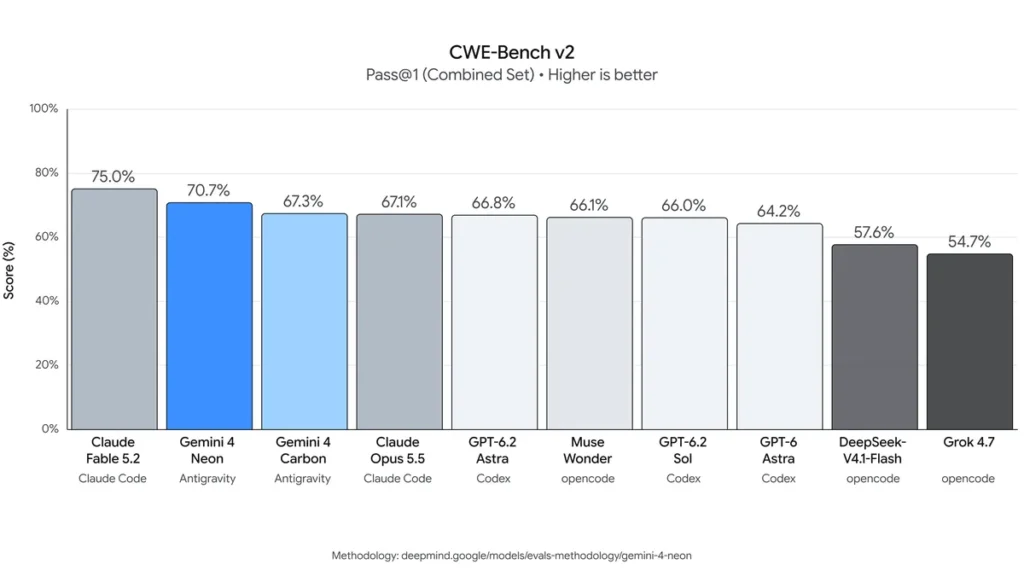
| Patching | 70.7% on Collinear's CWE-bench v2, a 3.4% uplift over Carbon. |
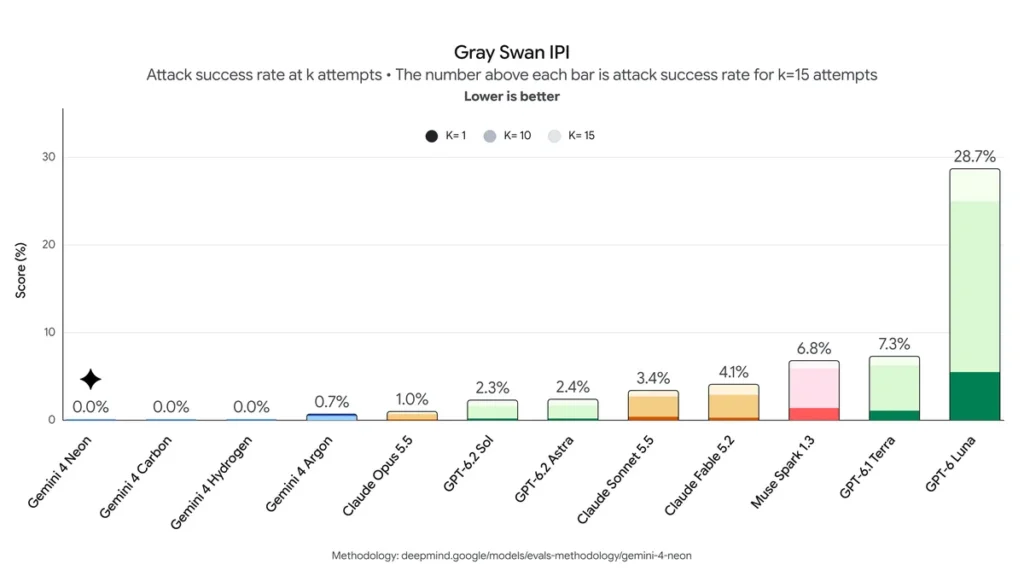
Neon builds on the Gemini 4 safety and security stack, maintaining Carbon-level protections against severe misuse and prompt injection while advancing further on model alignment and agentic behavior.
In the Gemini app, Neon is aimed at work that requires frontier-level reasoning and fast responses:
Carbon tackles the hardest, long-horizon projects and Hydrogen handles fast everyday execution. Neon balances depth and efficiency, delivering frontier-level reasoning for complex, high-frequency workflows faster and more cost efficiently.
| Feature | Details |
|---|---|
| Intelligence: | 61 on the Artificial Analysis Intelligence Index at xhigh (#3 overall) – near the top, just behind larger, slower models. |
| Cost per task: | 32% lower than Carbon at high; 36%+ less than competitors at their highest setting – frontier performance with lower spend. |
| Context window: | 1 million tokens – spreadsheets, PDFs, charts, audio, and video in a single pass. |
| Coding agents: | #1 on the Artificial Analysis Coding Agent Index (58.6), and 39.0% on SWE-sweep in Google Antigravity – reliable long-running, multi-file engineering work. |
| Steerability: | #2 on the Agent Arena Index – adapts cleanly to mid-task corrections. |
| Cyber: | 90.5% on SEC-bench Pro and 76% on AutoBaxBench hard – vulnerability finding and secure code generation at lower cost. |
| Safety: | 0.09% misaligned action rate and 99.2% agent honesty pass rate – more dependable long-running work. |
Gemini 4 Neon is rolling out in the Gemini API in Google AI Studio, in Gemini for business (via API and model dropdown), for paid Google AI Pro and Ultra subscribers in Google Antigravity, and for Pro and Ultra subscribers in the Gemini app. Pricing is $3 per million input tokens, $0.15 per million cached input tokens, and $15 per million output tokens.