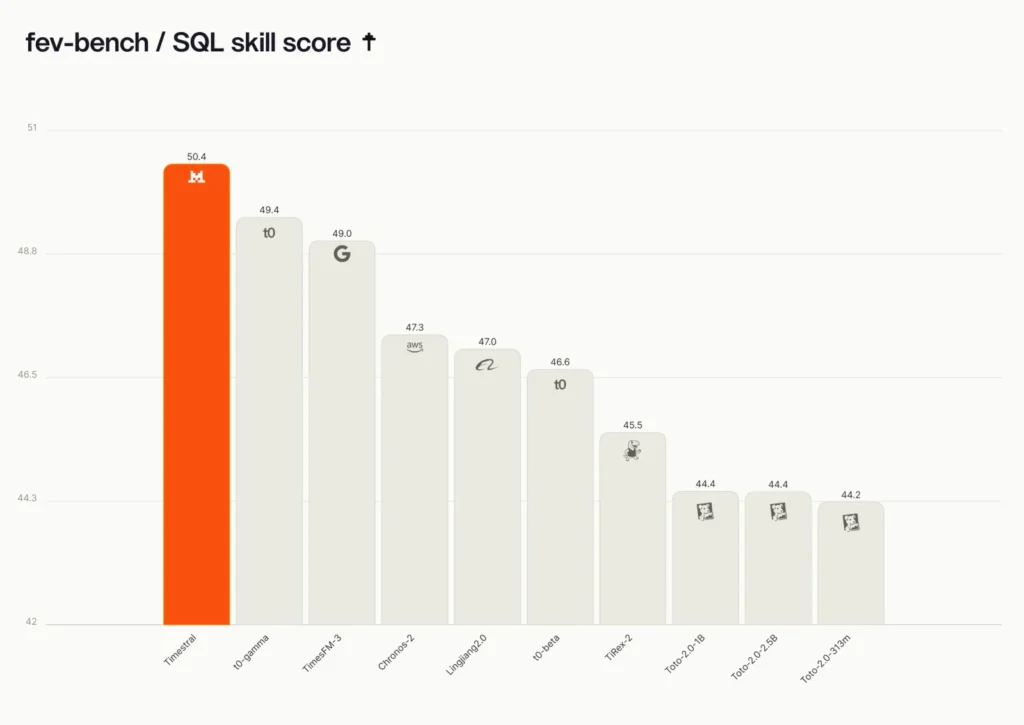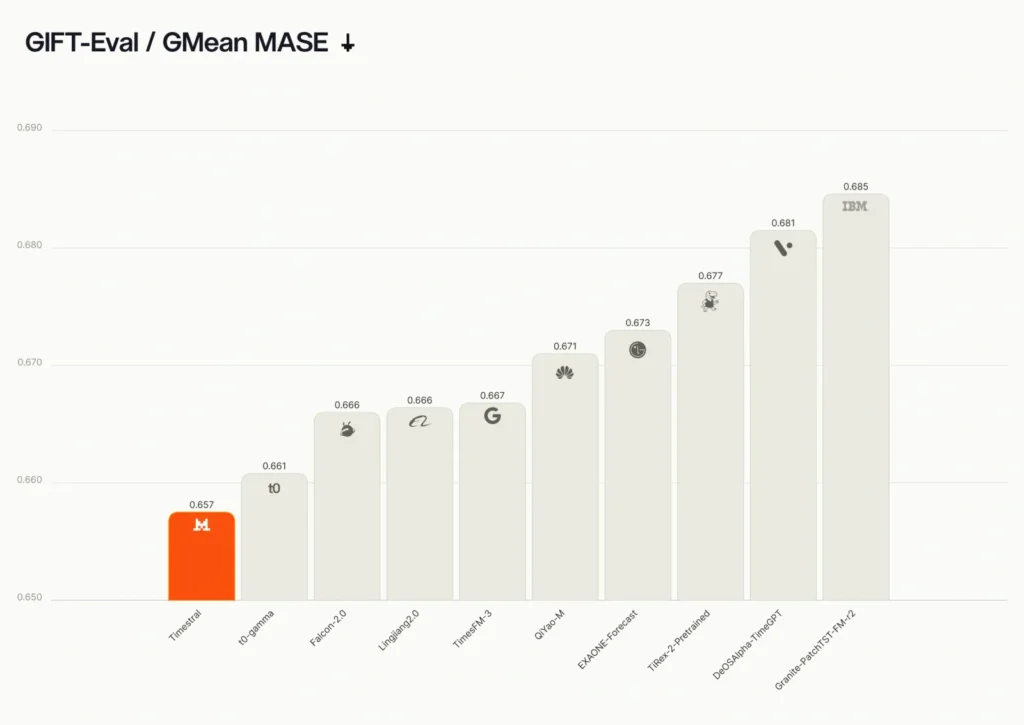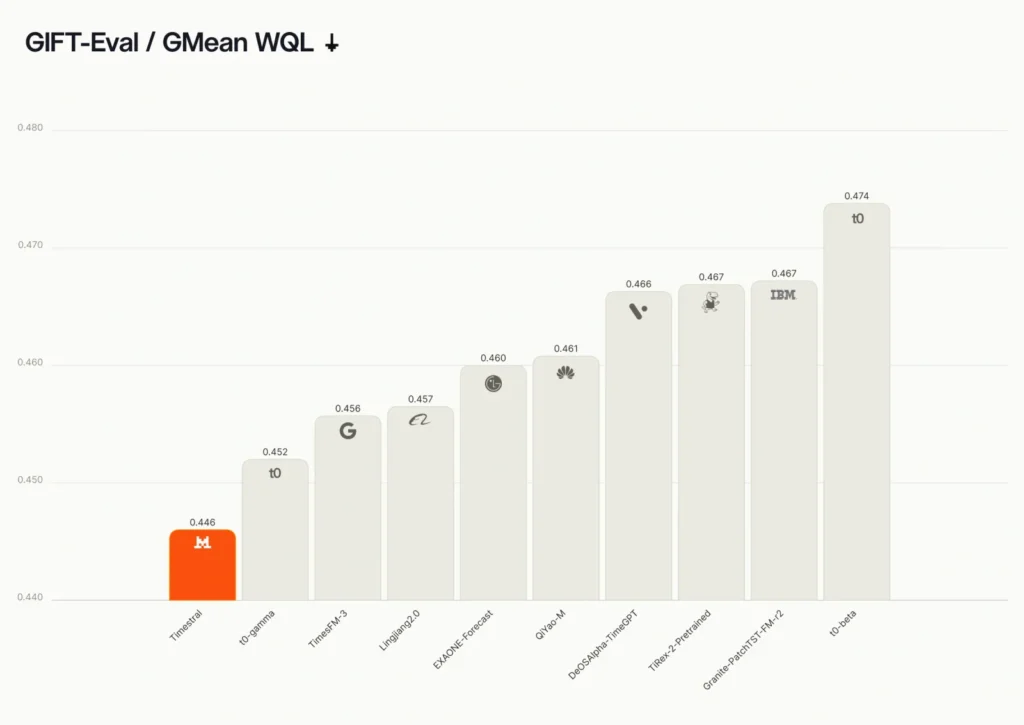
Timestral ranks first on all three forecasting benchmarks
Timestral is a new family of time-series foundation models. Its largest model has 209M parameters and ranks first on GIFT-Eval, TIME, and fev-bench. The article says this beats the previous state of the art while using only two-thirds of its parameters. Time-series forecasting has mostly relied on models trained for one dataset at a time, so a pre-trained model that forecasts well on data it has never seen is a significant change.
Time series is one of the most common data types in enterprise, from sensor telemetry to observability metrics. Forecasts built on it drive decisions in capacity planning, energy, supply chains, risk, and maintenance. Industrial plants forecast process sensors against production schedules, catch equipment drift before it fails, and plan capacity and spare parts across thousands of assets. Finance teams forecast flows, volumes, and volatility to inform positions, hedging, and treasury.
Classical models such as ARIMA and linear regression are well established, but they are usually fitted to a single series and learn only from that series' history. Deep learning models such as PatchTST can learn nonlinear patterns across many related series, but they are typically trained from scratch on each dataset, so what they learn does not carry over to new domains. Time series foundation models (TSFMs) apply the pre-training approach to time series. Trained on a large and diverse corpus, they learn patterns that transfer across series and can forecast zero-shot on data they have never seen, including in domains where data is scarce.
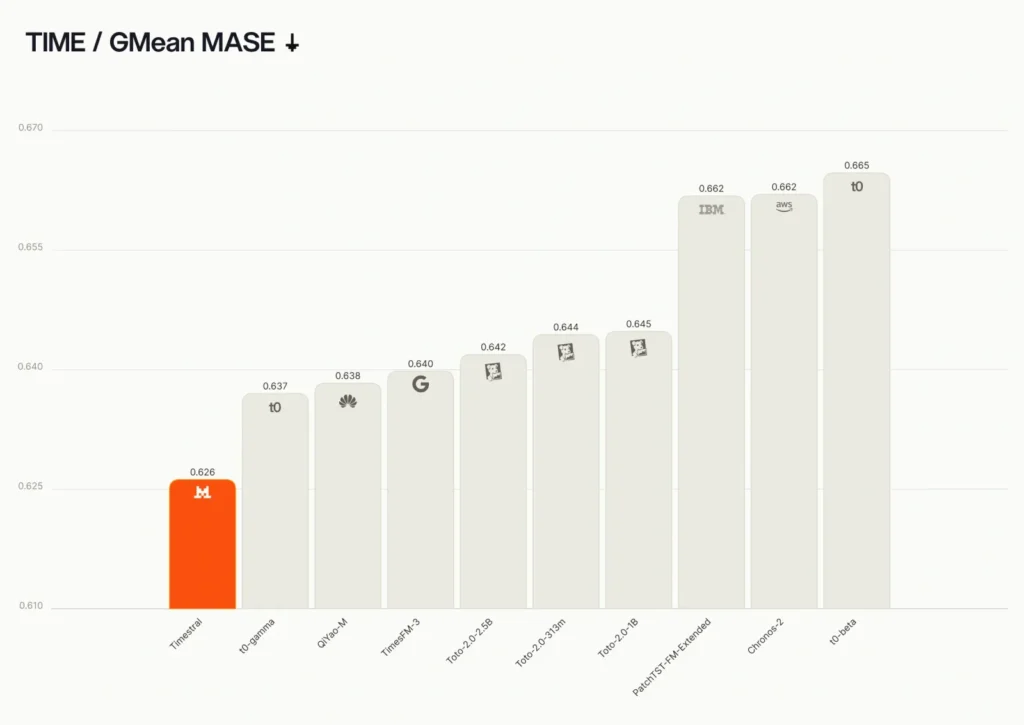
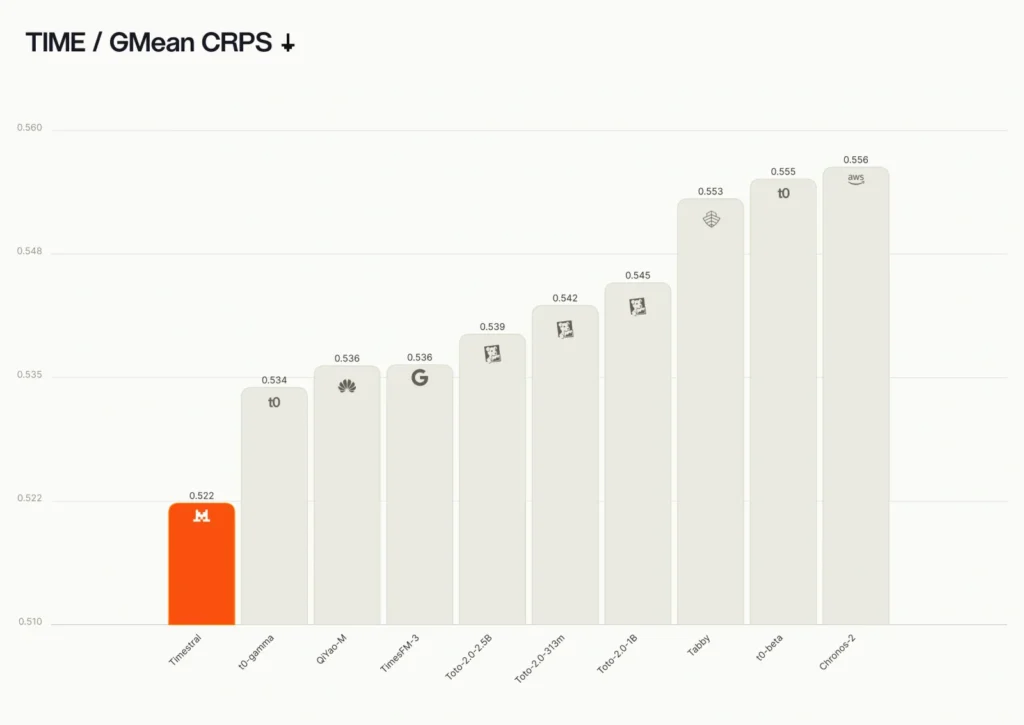
The team evaluated Timestral on GIFT-Eval, TIME, and fev-bench. Among pre-trained, zero-shot models, it ranks first across all five metrics. These results come from a single checkpoint, without ensembling. The results have been submitted to the GIFT-Eval and TIME leaderboards. The article also notes that its model family sits on the Pareto front of forecasting accuracy versus model size, meaning that for each model size, no public model forecasts better.
Timestral comes in four sizes: 5M, 28M, 123M, and 209M parameters. Larger models improve forecast performance, while smaller ones are faster and cheaper. All four share the same architecture and training recipe. The 28M model beats Chronos-2, which is about four times larger, on GIFT-Eval and TIME. The 209M model beats TimesFM-3 and Falcon-2.0 with fewer parameters.
Timestral does not need a GPU at inference. On a standard server CPU with 8 threads, forecasting one day ahead from three weeks of 15-minute history takes 10 ms with the 5M model and 140 ms with the 209M model. The 28M model is five times faster than the 209M model. The 123M model comes within 0.2% of the 209M score at three quarters of its latency.
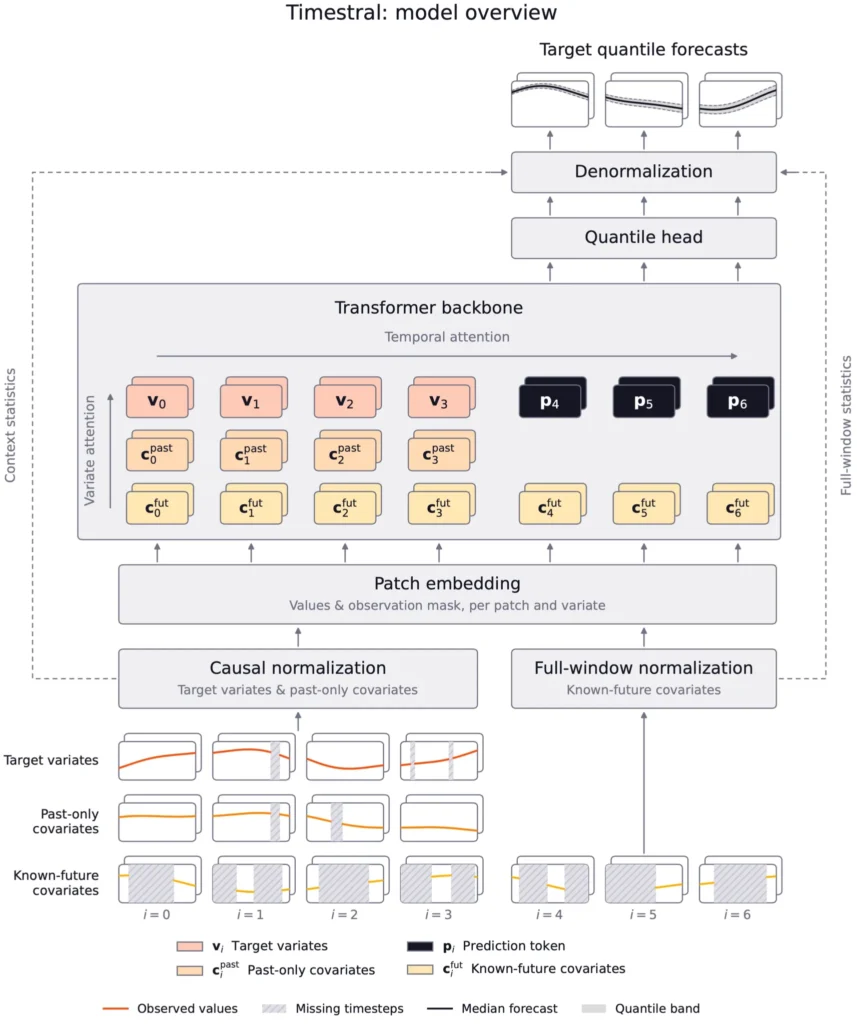
The article illustrates the model with an industrial plant that has thousands of sensors. Timestral improves forecasts in four ways:
Timestral is a numerical model that can run inside existing monitoring pipelines or be paired with Mistral's language models in multi-modal agentic workflows. In the plant example, Timestral runs continuously on sensor streams and detects anomalies. When it flags a pump, an agent compares the signals against embeddings of past sensor data to find similar historical failures. Sub-agents then run a root cause analysis using maintenance records, shift logs, operator notes, equipment manuals, past work orders, and readings from related equipment. The agent drafts a suggested diagnosis with supporting evidence and possible next steps, so the plant manager receives a diagnosis and plan backed by sensor data rather than just an alert.
The article credits four ideas for the results, and says each will be described in detail in a forthcoming technical report:
Public benchmarks measure general performance, but production data can differ significantly in behavior and structure, and it can shift as markets change, equipment degrades, and demand patterns move. The article argues that the lasting value lies in adapting a model to in-domain data and retraining it as the distribution changes. Through Mistral Forge, the same training pipeline used for Mistral's language models, organisations can get zero-shot inference out of the box, add architectural extensions such as domain-specific covariates, fine-tune on proprietary data while preserving general performance, and control the training data, including the training mix, replayed pre-training data, and synthetic samples reflecting the target domain. The article says this control ensures nothing backtested was seen during pre-training. The full pipeline can be deployed on client hardware, including air-gapped environments.
The article says Timestral is being released today, but it gives no specific release date. Timestral is available through a GitHub repository for running it on your own data, and through Mistral Forge for fine-tuning and customization. The licence is a modified MIT licence. A technical report with full results will follow. The article invites readers with more specialised forecasting problems, or interest in research collaboration, to get in touch.
The published comparison includes TimesFM-3, Toto-2.0-2.5B, Chronos-2 and t0-gamma. Lower scores are better for the GIFT-Eval and TIME error metrics, while fev-bench reports skill scores.
The published comparison includes TimesFM-3, Toto-2.0-2.5B, Chronos-2 and t0-gamma. Lower scores are better for the GIFT-Eval and TIME error metrics, while fev-bench reports skill scores.
| Benchmark | GIFT-Eval | GIFT-Eval | TIME | TIME |
|---|---|---|---|---|
| Metric | MASE | CRPS | MASE | CRPS |
| Timestral-209M | 0.658 | 0.446 | 0.626 | 0.522 |
| t0-gamma | 0.661 | 0.452 | 0.637 | 0.534 |
| TimesFM-3 | 0.667 | 0.456 | 0.640 | 0.536 |
| Toto-2.0-2.5B | 0.696 | 0.476 | 0.642 | 0.539 |
| Chronos-2 | 0.698 | 0.485 | 0.662 | 0.556 |