A Crimson Desert game box sits on a textured surface beside a sword and miniature desert diorama.
Crimson Desert marks a significant shift for Pearl Abyss, translating its experience in massively multiplayer systems into a dense, single-player open-world adventure. Released on March 19, 2026, the game attempts to combine a wide spectrum of mechanics and design philosophies into one cohesive package. The result is a sprawling and ambitious experience that frequently alternates between moments of brilliance and clear structural shortcomings, reflecting both the studio’s strengths and its growing pains outside the online space.
A Vast and Reactive World
Set across the continent of Pywel, the game delivers a visually striking world filled with diverse biomes and a strong sense of scale. Its systems-driven design allows players to engage in a wide range of activities, from hunting and fishing to settlement management, gambling, and even economic ventures like trading. Non-playable characters follow routines, caravans operate in real time, and events unfold dynamically across regions, contributing to a convincing sense of a living world.
This breadth of interaction creates emergent gameplay opportunities, whether tracking targets across towns or experimenting with off-path exploration. However, the sheer number of systems also leads to inconsistency, with some mechanics feeling polished and engaging while others lack refinement or clear guidance.
Narrative Inconsistencies and Character Focus
The story follows Kliff, a mercenary attempting to reunite the Greymane faction after a devastating ambush. While the premise suggests a focused character-driven narrative, the execution struggles with pacing and coherence. Tonal shifts between fantasy, science fiction, and steampunk elements create a fragmented storyline, often weakening emotional engagement.
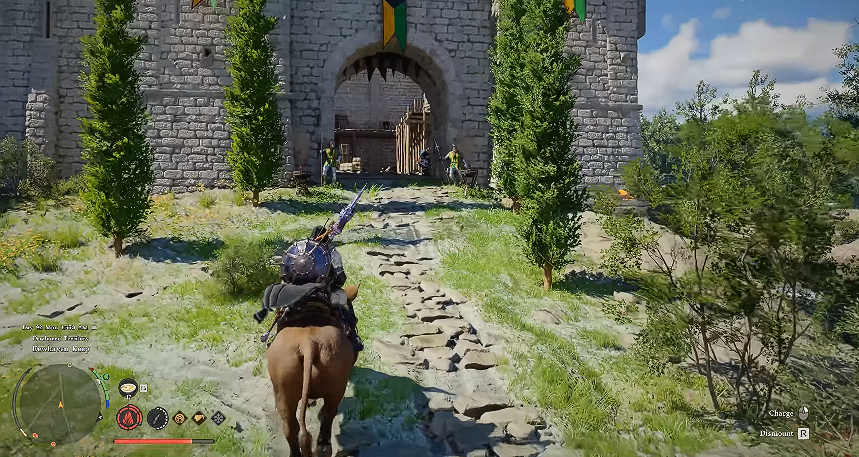
Source: Screenshot from game
Side quests provide a notable contrast, offering more grounded and character-driven moments. Supporting figures such as Yann and Naira add personality and context to the world, highlighting the potential of the narrative when it narrows its scope. Despite three playable characters, the story remains heavily centered on Kliff, limiting the impact of character switching.
Systemic Ambition and Design Friction
Crimson Desert’s gameplay is defined by its overwhelming density of mechanics. Activities range from mini-games like arm wrestling to more complex systems such as crafting, resource management, and exploration puzzles. While this variety reinforces player freedom, it also exposes uneven design quality.
Several systems introduce friction rather than depth. Inventory management is particularly restrictive, especially at launch when storage options were absent, forcing players to discard valuable items. Fast travel is intentionally limited, often requiring additional steps that disrupt pacing. Similarly, certain mechanics, such as horse taming or puzzle-solving, can feel unintuitive or poorly communicated.
Combat, Boss Design, and Progression
Combat stands out as one of the more engaging aspects, built around a hack-and-slash framework enhanced by skill trees and upgrade systems like Abyss Gears. Abilities can significantly alter playstyles, adding mobility or new offensive options. However, encounter design frequently undermines these strengths.
Standard battles often extend unnecessarily due to large enemy waves, while boss fights introduce abrupt difficulty spikes. These encounters shift toward multi-phase, high-pressure scenarios that feel disconnected from the broader combat flow. Combined with balance issues and reliance on healing items, they can disrupt pacing and reduce overall enjoyment.
Technical Performance and Stability
Technically, the game performs well across a variety of hardware configurations, maintaining stable frame rates and impressive visual fidelity even on mid-range systems. This level of optimization is notable given the scale of the world and the density of on-screen elements.
However, performance stability is offset by persistent technical issues. Players may encounter bugs ranging from minor animation glitches to more severe problems such as crashes or broken quest progression. Although post-launch updates have addressed some of these concerns, including the addition of storage systems and other quality-of-life improvements, the overall experience remains affected by these inconsistencies.